
“And looking ahead at the rest of my time here, I think this speaking club is exactly what Fulbright is trying to support: the exchange of ideas and cultures in a friendly setting for the ultimate betterment of people and the world.”
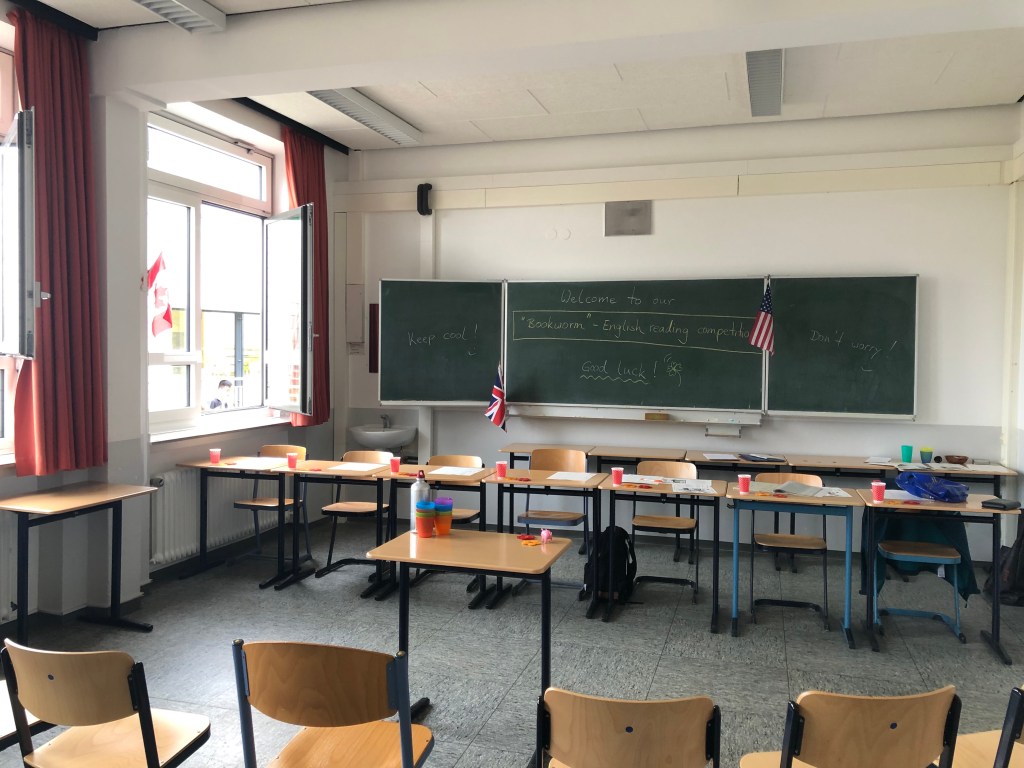
As an English Teaching Assistant, I’m supposed to accompany teachers in their classes for about 12 lessons each week, with each lesson lasting about 45 minutes. An ETA’s schedule can vary depending on which school one is placed in; for example, my schedule has 5 fixed lessons each week with two Cambridge English Exam prep courses, which are actually extracurricular activities, and the other fixed lesson being an English speaking club–something a little more relaxed than my German recitations I was required to attend at Tufts.
The remainder of the time I have to spend at school each week is determined when teachers invite me to come and assist them in their classes. Some of the other people I know from Fulbright don’t have the same experience with their schedules. According to the guidelines set by the PAD (the German Educational Exchange Service), schools are technically supposed to provide all Foreign Language Assistants (FSAs–from Fremdsprachenassistenten in German) with a schedule to help in specific classes each week. Some schools however, like mine, want to make the most out of having a FSA, which is something that isn’t guaranteed every year, and so they want to make sure most of the kids get a chance to work with them.
I’d say that having an open schedule comes with its advantages and disadvantages. One really great thing is that because of the days when I have a fixed schedule (Wednesday and Friday), I’m able to have at least Mondays and potentially even Tuesdays off if I want. This would allow me time to travel to different places spontaneously should the opportunity arise.
However, a couple of disadvantages with this scheduling system has been that it takes a little bit for teachers to reach out to me and invite me to their classes. As an example, tomorrow is Friday and I don’t know whether I’ll be able to fill my hour requirements for next week since teachers haven’t reached out to invite me to help them yet. Another disadvantage to this schedule in terms of my performance as an ETA is that visiting so many different classes means I’m meeting hundreds of students, and it’s taking me a while to learn names. This makes it feel like I’m not able to connect with the students on a more personal level, which is something I believe the Fulbright Program means to foster and encourage in host schools.
But on a more positive note, my experience so far with my fixed lessons each week have been fun and meaningful. As I said, I lead an English speaking club offered to the 11th graders due to the fact that a lot of these students are coming back from being abroad in an English-speaking country. It’s been hard to find a balance of discussing topics that will challenge the students and keeping a fun, relaxing environment where they can speak freely. In the first meeting that we had I showed them a clip of the TV show Ghost Hunters because it was close to Halloween, and they absolutely loved it. They were shocked to learn that approximately 45% of Americans believe in supernatural spirits of some kind, compared to the 17% of Germans. They certainly found the show entertaining, not really because they believed that evidence of ghosts was being captured on the hunters’ devices, but because they believed the whole thing was quite funny.
Moving from that week to the next, I decided to bring a transcript of a NPR report regarding the “perennial problem of cultural appropriation through Halloween costumes” in the United States. As someone who has been to Germany before and has studied a lot about German culture, I know that there is a lack of sensitivity toward other cultures in the country, and I was interested to see how the students would react. The report talked about how stores in the US sell costumes that depict caricatures of certain cultures, like that of Native Americans or even Mexicans. After giving them time to read the report, I asked them what they thought about it and if it was something that was a problem in Germany. I wasn’t very surprised when most of the students said that they didn’t find an issue with wearing such costumes: that if people seriously scrutinized every costume that people wore during Halloween or Karnival or other costume parties, then such parties wouldn’t be fun anymore.
I went back to a line in the report which stated that the caricature of Native Americans depicted through these costumes comes from a time where several thousands of Native Americans were either slaughtered, raped, killed by European diseases or forcibly removed from their land. I then asked the question again: knowing this history and about the plight of these people, is it appropriate to wear that as a costume to party? Now, I’m not sure if I was totally able to change their minds on the matter, but they clearly seemed to think more about the implications. One student was even able to admit, “It’s hard to say.”
What I want to be able to do with this speaking club is not paint an entirely wonderful picture of the United States. I think it would be dishonest to do so. Our country is seriously flawed in its own ways. While I want to show them that the US is a great country in my mind, I also want to introduce them to the issues that people there currently discuss, which will hopefully allow them to consider the issues in their own country of Germany as well. The treatment of people with migration backgrounds (not the friendliest of terms, either) is a serious issue in Germany today. And looking ahead at the rest of my time here, I think this speaking club is exactly what Fulbright is trying to support: the exchange of ideas and cultures in a friendly setting for the ultimate betterment of people and the world.
So while my schedule is all over the place for now, I’m happy for those fixed times during the week where I know that I am making a more personal impact with my students.
 Teacher Tommy's Travels