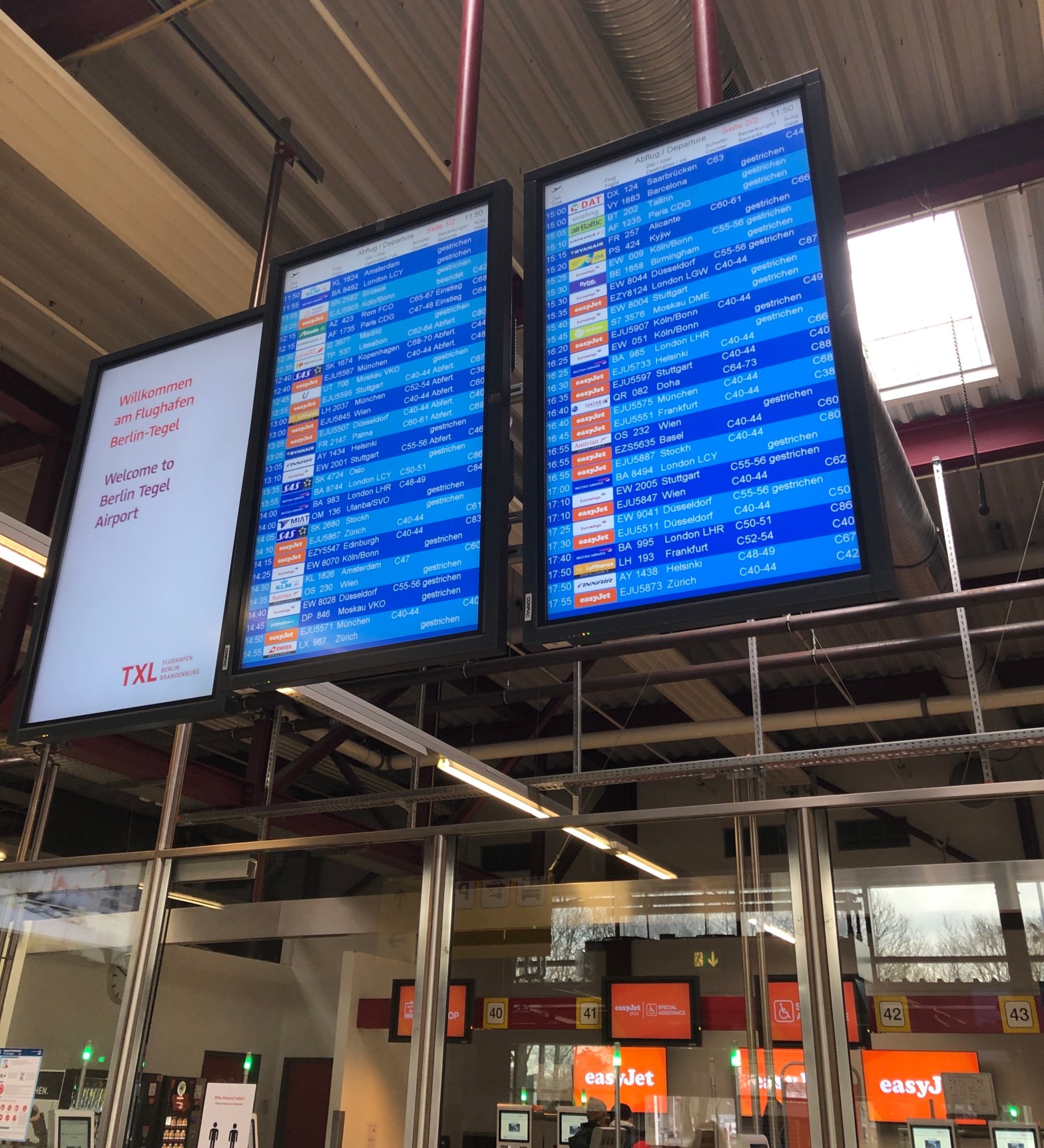
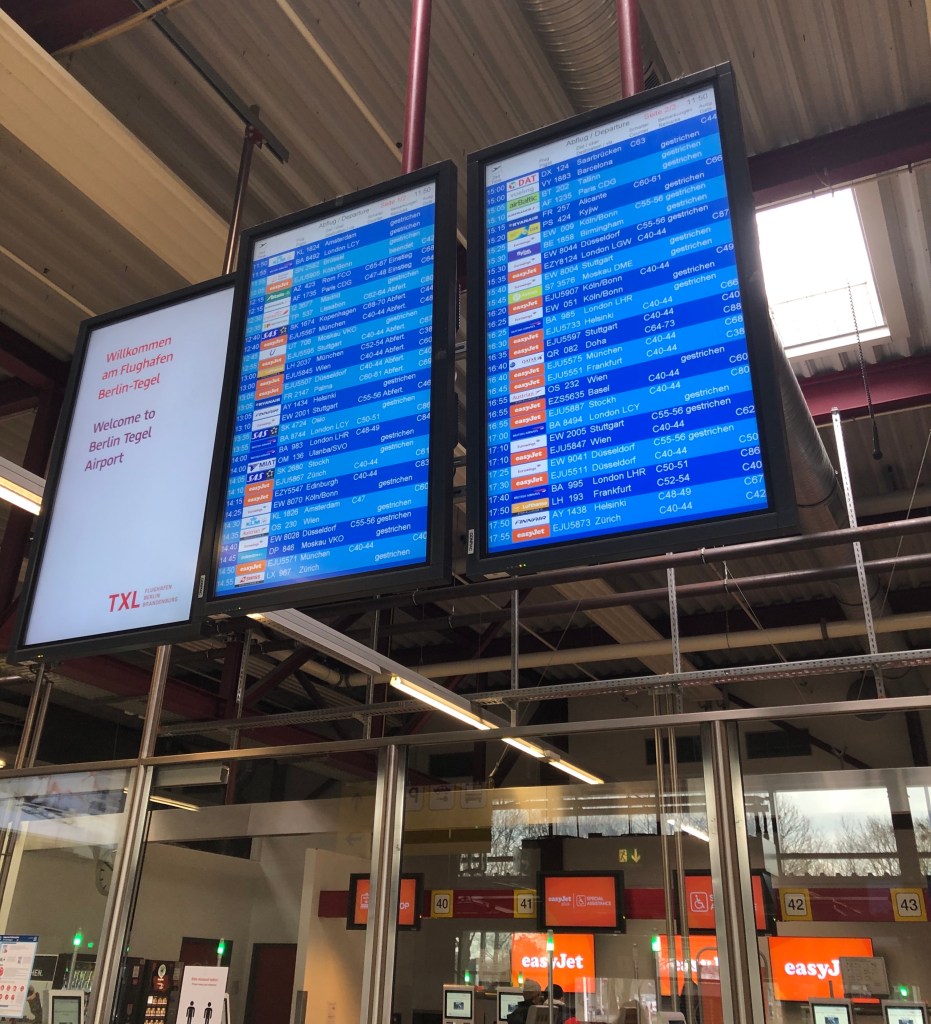
The departures board at Tegel Airport in Berlin showing almost half of scheduled flights are cancelled.
Today is the day that I was supposed to be in Berlin as a part of Fulbright’s celebration of the program’s partnerships across Europe and its mission to further intercultural exchange. Instead, I’m sitting in the kitchen in my brother’s apartment in Lowell, MA. Instead of staying in Berlin with the friends that I have made, I’m with my brother here, and I’m sleeping on his couch. I decided that it would be best during the first couple of weeks being back in the US to stay out of my house in Waltham, where I could potentially unknowingly infect those who might be more vulnerable to COVID-19.
I’m finally starting to process what exactly has happened the last two weeks. As you may have read in my last post, there were a series of events that unfolded in the week prior to finally deciding that it would be best to return home. Things really ramped up toward the end of the week, as schools closed down, travel advisories were changed, and we were encouraged to return home. I had several logistical questions on my mind, and over the weekend we unfortunately didn’t get much communication from our Fulbright program coordinators. This event is unprecedented and quickly developing, and we were told by Fulbright Germany that information was constantly being updated, and they wanted to take time to give us the most accurate information.
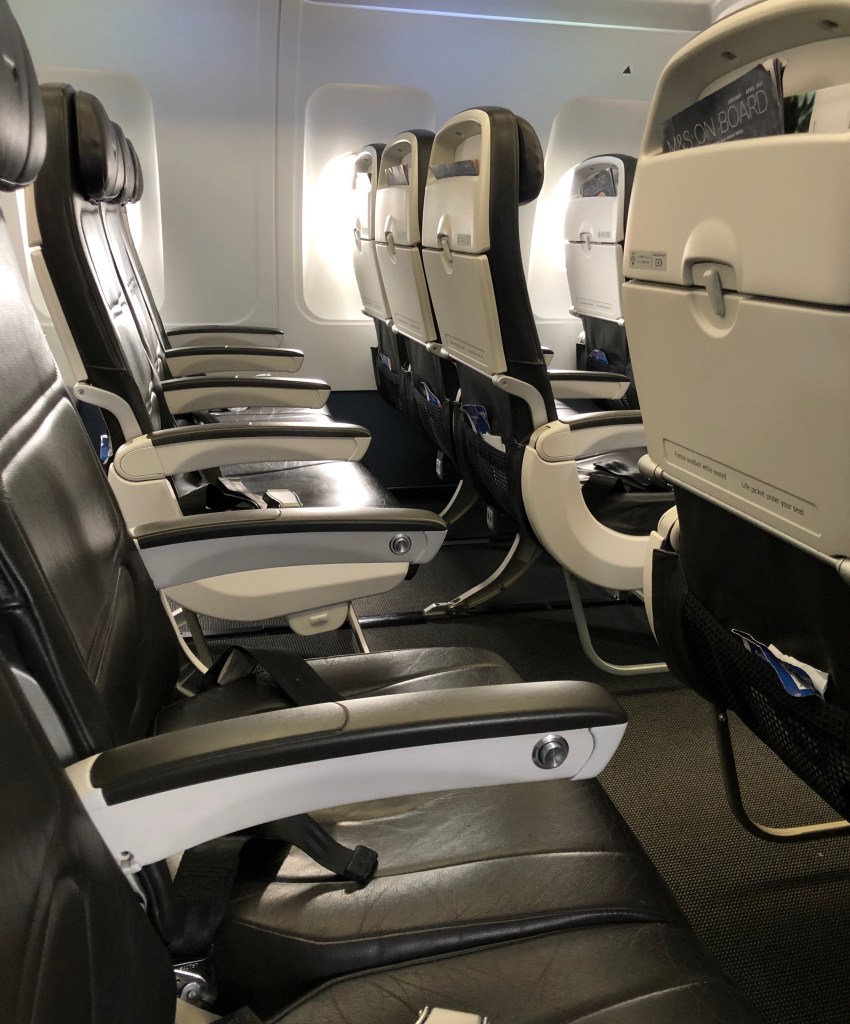
Seats next to me on my flight from Berlin to London. Approximately 30% of the seats in the flight were filled.
Fulbright gave us logistical information regarding our evacuation Monday evening, but by that time I had already made my decision. With several flights being cancelled every day, and uncertainty about the possibility to travel in the future, it became less and less clear what my future in Germany could be like if I stayed there. If I were stuck in Germany without a job lined up, it would certainly not have been the best situation for me financially.
Another thing that factored into the decision is how life as I knew it in Germany was likely not going to be the same for a while. Schools in Lower Saxony are closed AT LEAST until April 20th, and there are rumors that either schools could remain close for longer after that. The Bundesland of Bavaria announced that they were implementing an order for people to remain indoors, like the measures that were implemented in Italy and Spain. While the Federal Government in Germany is currently asking for people to practice social distancing, there could be similar lockdown measures put in place nationwide; the circumstances of life in Germany could change without little advanced notice.
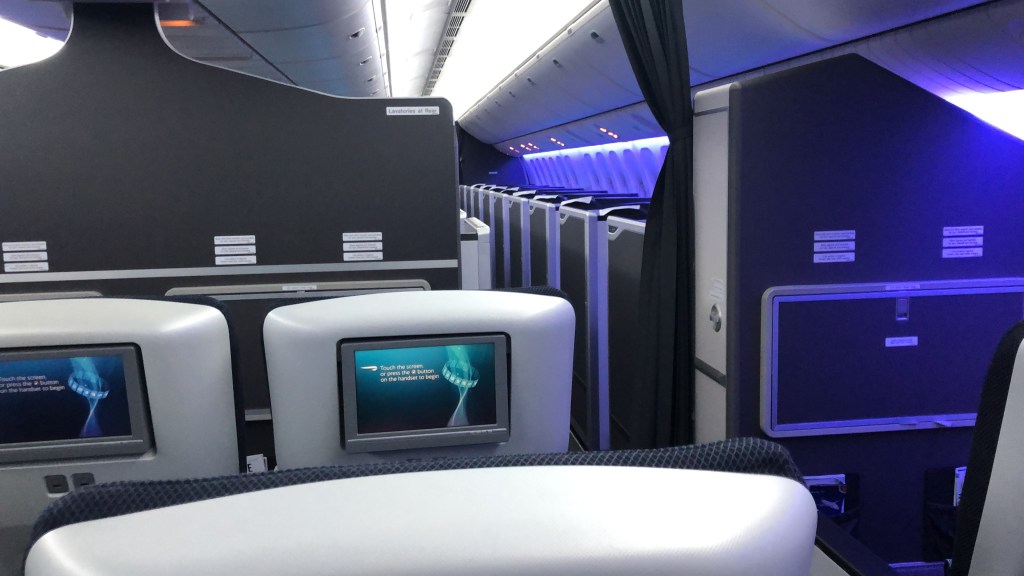
I flew in the Premium Economy class on my flight from London to Boston. Only 5 people were sitting in this cabin, one in Business, a few in First, and around the same percentage of Economy seats filled in the back of the plane. Health screening and security took all of 10 minutes. The quickest experience I’ve had coming back from abroad!
Actions that certain places and countries in the world have taken have taken a toll on travel and tourism as industries, and with good reason! At this moment in time as I’m watching the President’s press conference on the United States’ coronavirus response, there are 12,755 reported deaths around the world out of more than 270 thousand reported cases. The best thing to do right now is to stay home. And while it would be nice to have been able to stay home with the friends that I have made in Germany, it is probably better to be with family at home during this time.
Half of the reason for writing this article is to inform you all of things that went into finally making a decision to come home, and the other half is to remind myself that I made the right choice. I’m sure in the coming weeks I’ll reflect more on the time I was in Germany, but for now I think I’m still trying to process what has gone on in the last two weeks. As my thoughts become clear, I will be back to post those reflections.
By now it isn’t a secret that the novel coronavirus has spread far and wide throughout the world. It’s been quite an ordeal as things have developed so quickly here over the past few weeks. The situation in Germany alone escalated quickly over the last few days, and I’m still waiting for more updates from Fulbright Germany regarding the next steps for us as program participants. This post will sort of be a stream of thought as I try to process what has happened. With that in mind, here is what has gone on in the last week alone…
At the beginning of the week, the numbers regarding those infected with COVID-19 were relatively low compared to surrounding countries. Although it was known that the novel coronavirus was something to be concerned about, it was still a relatively normal beginning of the week at school.
The numbers of those infected in Germany seemed to rise slowly at first, and then grew exponentially. There was discussion about Europa League games being played behind closed doors, and while VfL Wolfsburg had originally planned to play the game open to the public, the decision was finally made Wednesday evening to keep their doors shut. Before I went to sleep that night, I had seen that President Trump was going to address the nation from the Oval Office, and the next day I learned that the world had been plunged into chaos here due to his European travel ban.
I saw stories of American families paying thousands of dollars due to the uncertainty of whether they could get home or not. For us Fulbrighters in Germany, we were unsure as to what this would mean for us. We got an email that said due to the designation of Schengen Area countries as Travel Advisory Level 3 countries by the CDC, that all State Department sponsored programs would be suspended for 60 days. On the same day, Lower Saxony decided that they would start the easter break two weeks early, meaning that schools would be closed in the state for at least five weeks.
We had a meeting in school about school closing, and after the announcement was shared with the students, school was essentially sent into focusing purely on the repercussions and how this would impact them. I was supposed to hold a practice exam for my Cambridge test prep group, but due to the situation and the lack of focus on school, it didn’t seem fair to make them sit through a mock exam, so I let them take it home for them to work on.
That evening, we finally received some communication from the program directors from Germany strongly encouraging us to leave the country and return home. After a long night of thinking and talking it over with people and massive stress, I have decided that the most prudent course of action is to return. I am still working through the logistics of packing up and moving out of my apartment and effectively shutting down my life here in Germany, so for those who might have questions, I already have an answer for you: I don’t know.
The situation is constantly changing and the world around me seems to get less and less flexible to travel. For the first time in a long time, borders within the Schengen Area are being closed, and checks are being implemented to prevent people from entering countries. I can’t help but think back to how just a few months ago I walked across a bridge from Hungary into Slovakia and no one batted an eye. This is something certainly taken for granted in today’s world, being able to travel as one pleases. I hope things return back to normal sooner rather than later…
So yeah, with such a rapidly advancing turn of events, my Fulbright year has come to an end. I will be returning home sometime in the next two weeks and will try to remain healthy in the coming months. This is all still a lot to process, and I’m sure I’ll be back here to reflect on what could have been and what was. Stay tuned…
More than half of my time here in Wolfsburg has passed, and even though the city center itself is quite small, there are some areas that I haven’t explored as much yet. The days are starting to become longer again, which has been a major boost for my overall state of well-being. During the darkest days of winter, the sun rises as late as 8:45 in the morning and sets as early as 3:50 in the afternoon. So with the sun shining today, I decided to get out of my apartment and to head into the city center and sit in this new cafe that opened this year, called Cafe Gaest. The place offers an option to make your own bagel sandwiches, something that I haven’t really found anywhere else in Germany, and better yet offers free WiFi, which is another rarity. There are plenty of tables to work at due to the fact that the cafe has two floors of seating, and it’s quiet enough to get some work done.
So here I am, writing to you from Cafe Gaest with not too many updates. While German winters can be dark, I have tried to use the warmer days to the best of my ability to explore different areas around me–and by around me, I don’t mean literally near my house, but rather either in the city center or in Brunswick (Braunschweig in German), where Eddy lives.
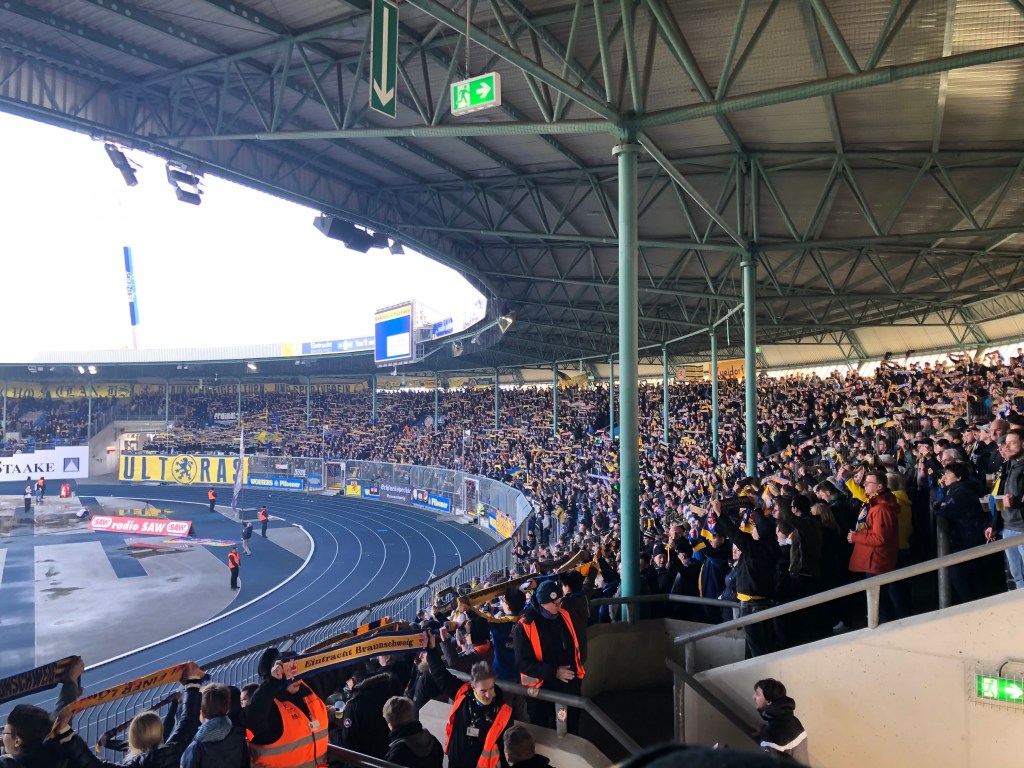
In the middle of the month after coming back from my short vacation in Spain, I was invited to Brunswick by the leader of the English faculty at my school, Jasper, to watch a soccer game between Eintracht Braunschweig and 1. FC Kaiserslautern, two clubs that have a long tradition in German soccer but currently play in the third division. Financially, the club isn’t as big as the Bundesliga club, VfL Wolfsburg, but within Brunswick there is a large following with their supporters that are very proud of their club’s history. Eintracht was founded back in 1895 and had had their own days in the Bundesliga, even winning the German title in 1967. The atmosphere from the crowd was energetic, and the team was even able to beat their foes for the day with an end result of 2-0. It’s also important to point out that Eintracht Braunschweig and VfL Wolfsburg are rivals of each other, so sorry to my friends here who have found out by reading this blog that I even went to an Eintracht game–please forgive me.
A view of the singing area of the Eintracht-Stadion, where there aren’t any seats and people sing and chant throughout 90 minutes to support their team.
The next day the weather was extremely nice, so Eddy and I went out to explore a little bit around his neighborhood, as well as a park only about a 20-minute walk from his apartment. Right down the street from his house was an area of the city that wasn’t damaged during World War II, and it was interesting to see some buildings built before then that still stood.
Continuing along the street, we finally came up to an area bordering the park on the outskirts of the city, which looked as though we had come to the countryside and completely left the city behind. This part of the city was made up of small areas of land that made up a few Kleingärtnervereine, which are clubs where people can rent a small plot of land and can have their own garden, as garden space isn’t too common in bigger cities. Some people have simple gardens, while others have interesting knick-knacks and other things to make their gardens unique, such as a tree house for example.
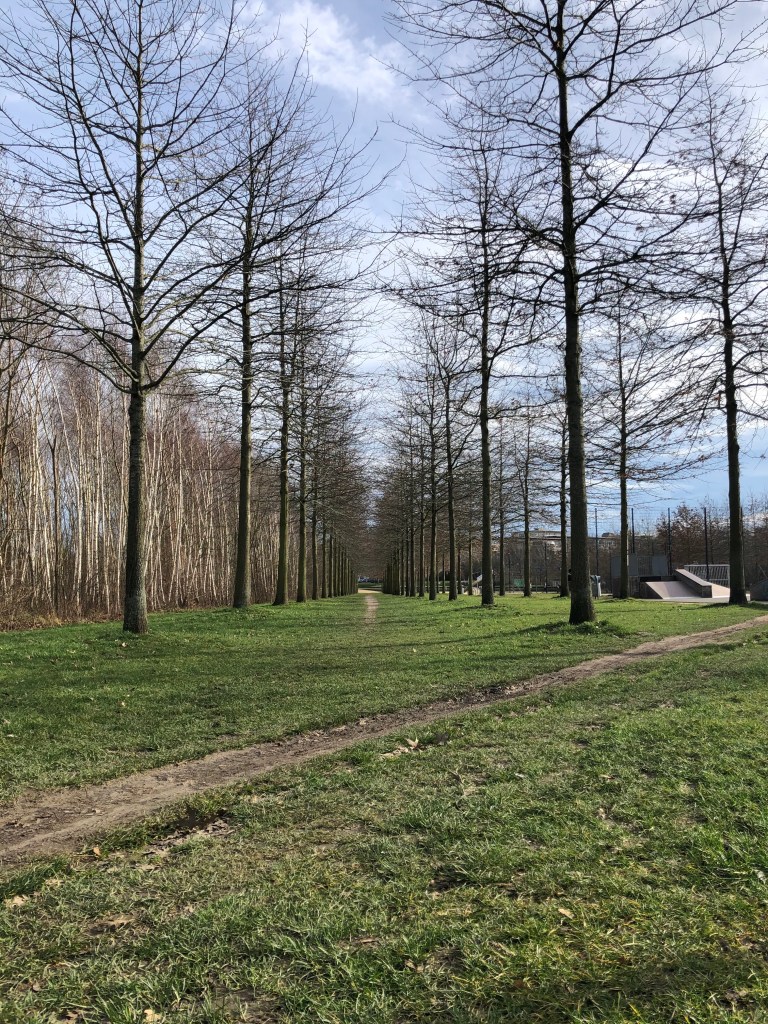
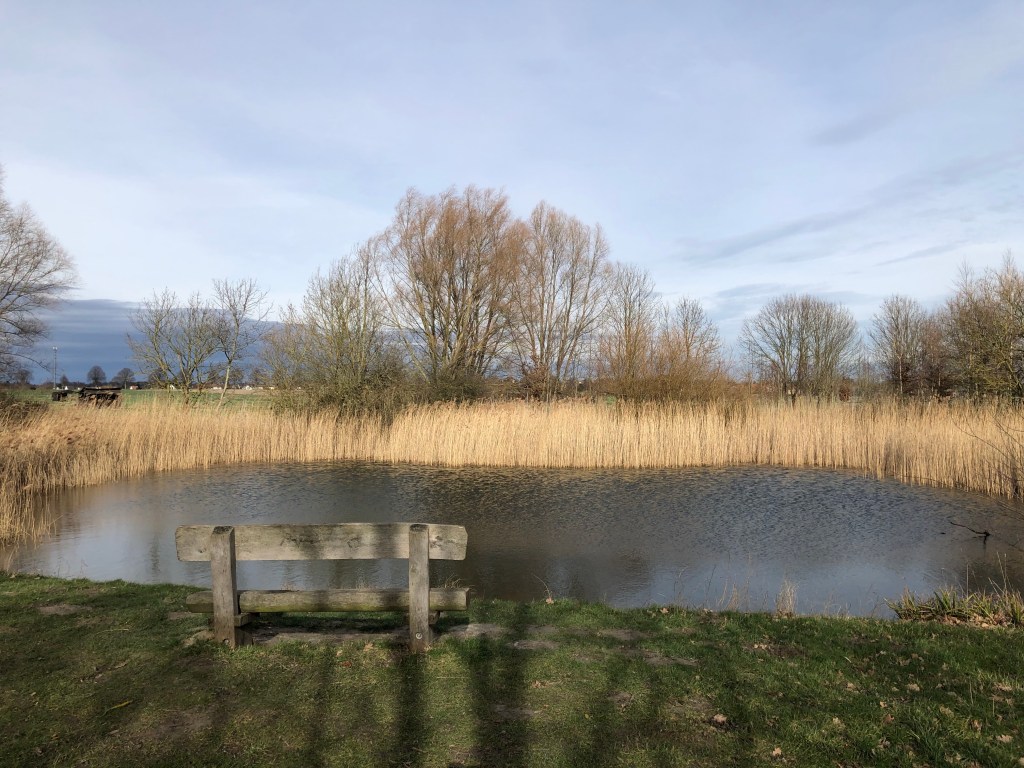
We finally got to the park and while part of it seemed very planned with paved paths and sport fields, others really seemed to be totally removed from the city, and it felt as though it was in the middle of pure nature. There were stretches of unpaved pathways that led through wooded areas, ran adjacent to a couple of ponds where geese paddled through the water, and passed through wide-open fields. It was quite refreshing to walk through the park and feel seemingly removed from the city life.
Thick woods to the left and a skate park to the right. Just an idea of how the park was planned.
A quaint pond located within the park, which felt like it could just as easily be found in rural Connecticut where my grandfather lives.
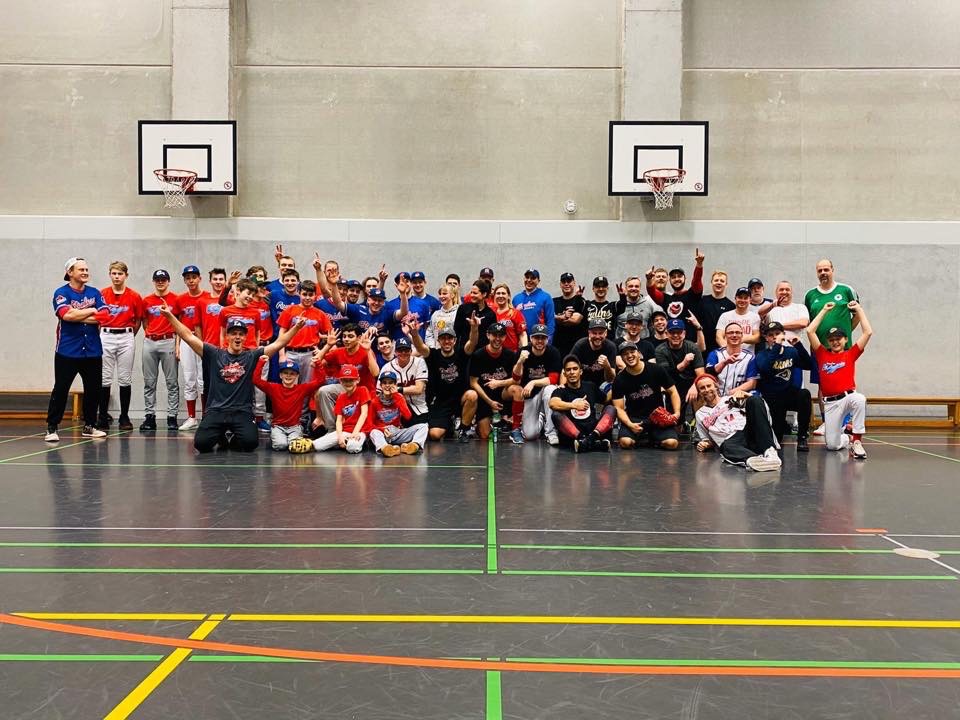
In contrast to the quiet pleasantness of the park in Brunswick, this past weekend I was in two of the largest cities in Germany, Hamburg and Berlin. I went to Hamburg with a few of my baseball teammates to take part in an indoor baseball tournament against a few teams associated with the Hamburg Stealers, a club whose first team plays in the Baseball Bundesliga. While the main point of the tournament was to enjoy playing some competitive baseball, our team ended up doing well finishing with a 3-1 record. It was fun to get back into playing baseball again as we look forward to the start of our season only one month away. After the tournament, we decided to head out to experience some of the nightlife that Hamburg is famous for before heading back to Wolfsburg the next morning.
A picture with the tournament participants. Thank you, again, to the Stealers for organizing such a fun event!
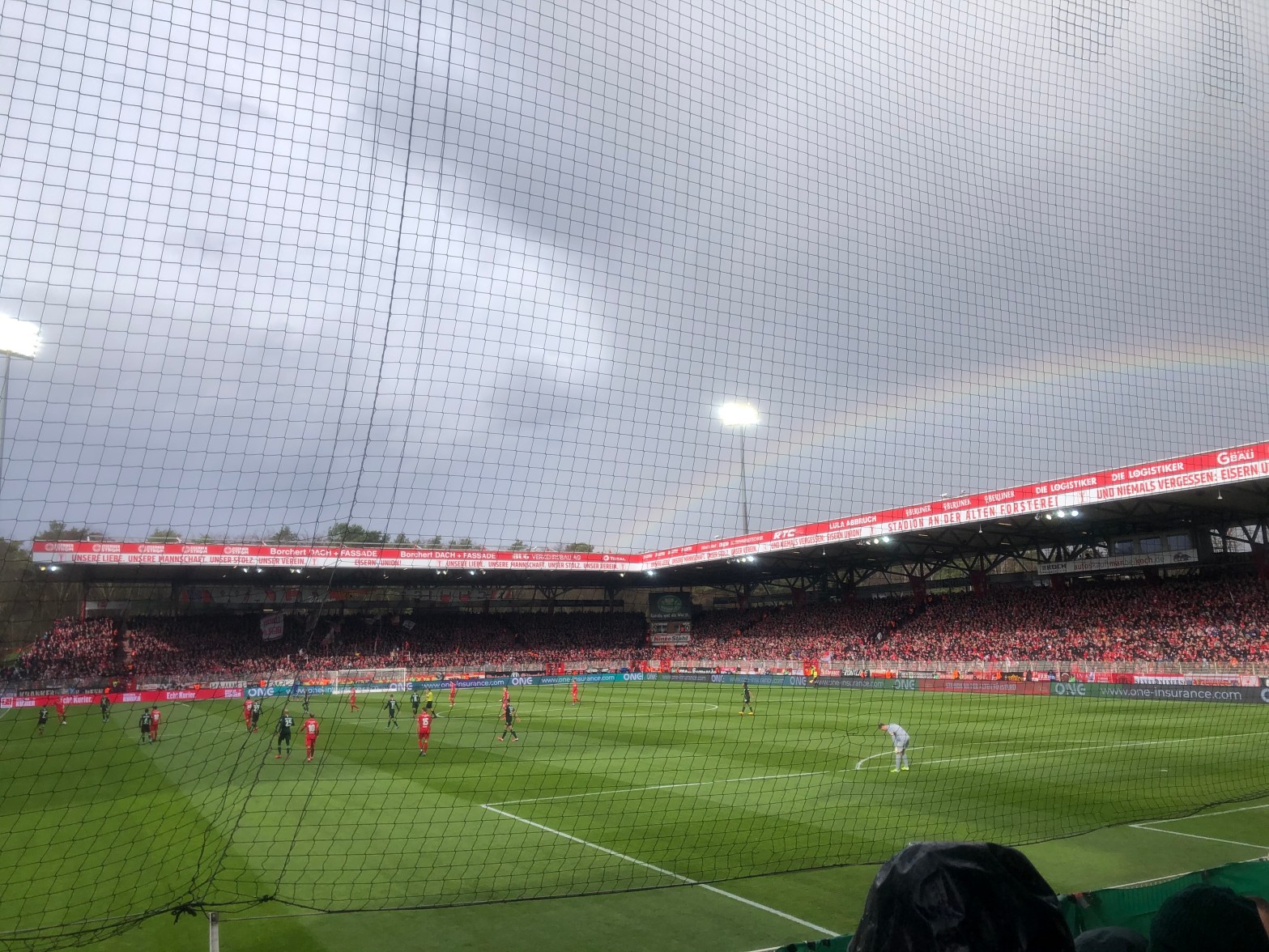
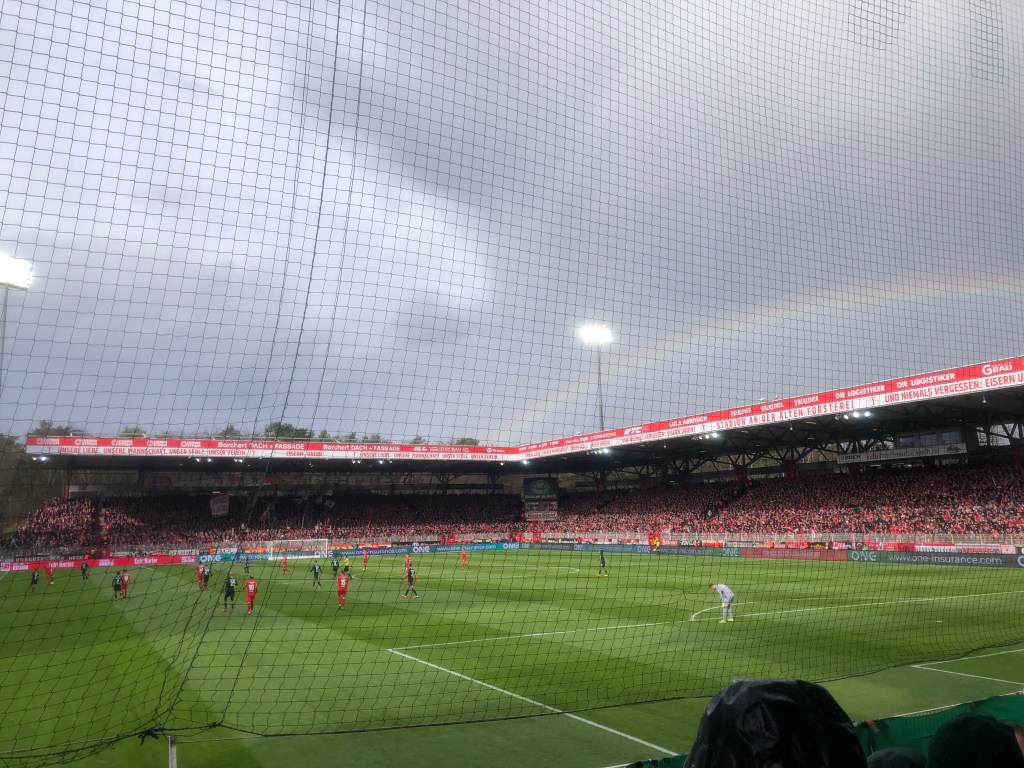
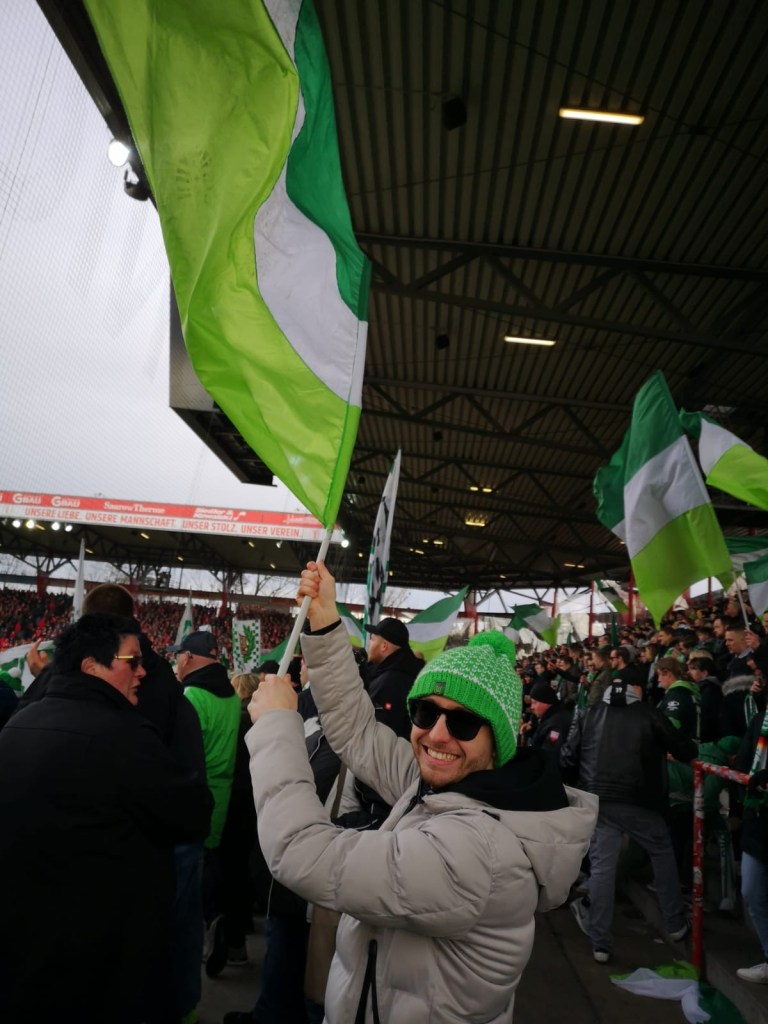
Finally, the month was wrapped up by a spontaneous road trip to Berlin with another baseball teammate of mine, Björn, and his coworkers from VfL Wolfsburg to support the team in their away match against 1. FC Union Berlin, a club steeped in history and a unique fan culture, being known for their “tifos,” which is a term for the type of choreography and displays fans create and show throughout soccer games. This is the club’s first time since reunification playing in the Bundesliga, and this season they are showing that they belong in the division currently sitting in the middle of the table, fairly clear of the relegation zone with a few months left in the season. This game supported that image of the club, as the atmosphere at the Stadion an der Alten Försterei was electric. Most of the spots for fans to watch the game are standing spots, meaning that most fans are on their feet singing, chanting, and supporting their club through different choreographies. It also allowed me to experience one of the more fun VfL Wolfsburg matches, as I was able to take part in the fan culture of singing and chanting, and even waving a flag with the club’s colors on it. The match ended in a 2-2 draw, but the experience is definitely one that I won’t forget.
A view from the guest block of the Stadion an der Alten Försterei after a rain storm passed through in the first half.
Taking part in the Ultras culture, waving a flag with the club’s colors on it.
There’s a lot in store this coming month with better weather on the way and another long vacation that will take place at the end of the month for Easter. Until that time, though, I will continue helping out in the school, going to baseball practice, and learning Spanish at the local Volkshochschule where adults can take courses on a variety of subjects. It’s good to have finally found a routine during the week that I can follow, which has made my experience a bit more eventful. With this routine, I’m happy to say that I feel much more at home now than I did a few months ago. I guess that could mean I’ve fully adapted to life here in Germany!
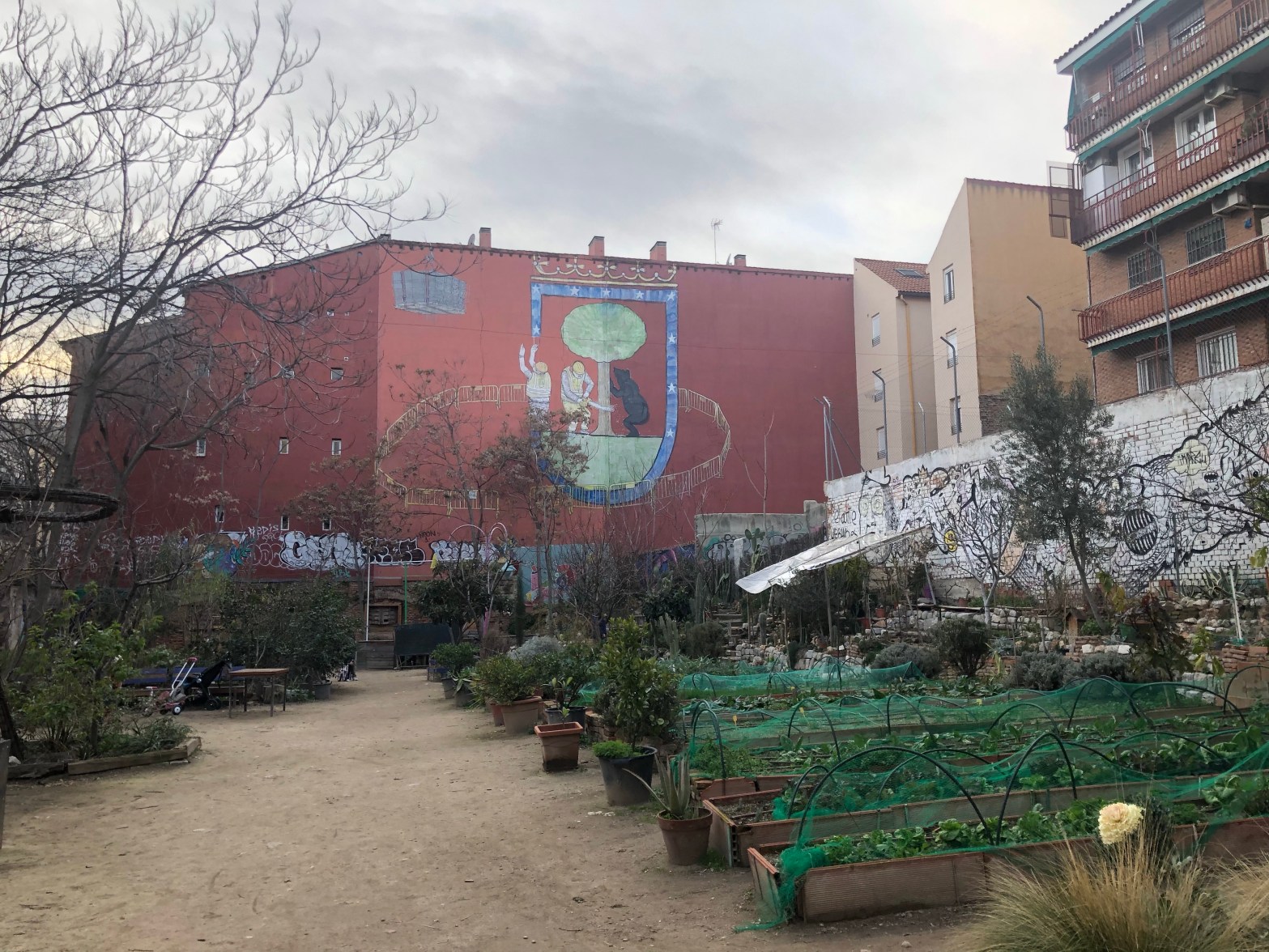
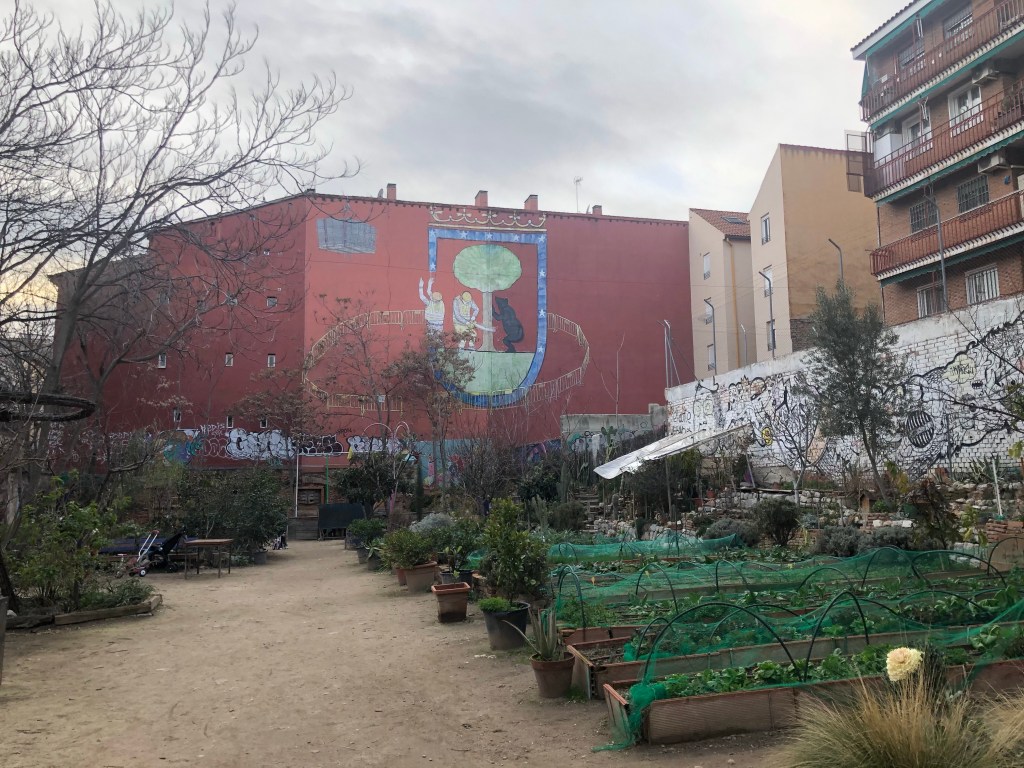
A hidden park I stumbled upon while walking through the Lavapiés neighborhood of Madrid.
Two weeks ago, the students at my high school received their grades for the first semester of the school year which culminated in a mini vacation of about four and a half days. During this time I went to Madrid to visit Sandra, and I happened to be in the city when the weather was relatively warm. While it was in the mid-40s in Wolfsburg, the temperature got up to around the mid-60s in Madrid, which was enough for me to walk around without having to wear a hoodie and soak in some sunlight. I explored parts of the city I haven’t been to before and was even able to watch the Madrid Derby in a local bar. The rivalry could be sensed in the bar, and I was even asked which side I was rooting for, but the atmosphere was also quite friendly and entirely enjoyable.
After a short, but fulfilling break, I came back to Wolfsburg last Wednesday (early in the morning) to start the second semester of the year. With the new semester have come some new challenges. I have been leading an extracurricular group (called an Arbeitsgemeinschaft in German, shortened to AG) for a group of 11th grade students who are interested in taking the Cambridge Exam for an Advanced Certificate of English. After the break, the schedules of all grades except for grade 12 change, which has presented a scheduling problem for this group, as one of the students isn’t able to attend the usual time for the Year 11 Cambridge AG, which means that I have to figure out a new time to meet for the group. Now I know what my German teachers in college went through when trying to organize our speaking recitations for a few different classes.
In the first semester I had some trouble with my own teaching schedule. I honestly can’t remember whether I talked about it in the blog, but my teaching schedule was very open, with only five set lessons a week with the other seven open for teachers to invite me to accompany them to their classes. The department head changed the schedule about halfway through last semester when teachers weren’t inviting me too much which gave me a set schedule of teaching around 13 lessons a week, take two if someone doesn’t invite me to accompany them. My schedule now includes consistent lessons with a Year 12 Leistungskurs (a higher level English course).
Although the second semester is a few weeks young, I have taken up a bigger role in the Year 12 course than I did last semester. With the new semester comes a new topic, which is namely diversity within the United States. This topic is one that comes with a little cultural and historical baggage for Germans, and it’s interesting to see how the unit is being approached here in Germany. To be fair, the dialogue about diversity and racial tensions is difficult for Americans to approach as well, but with the negative connotations that terms such as the words “race,” “nation,” and “national identity” have in Germany, it makes the conversation that much harder to talk about and understand. Americans may or may not know this about Germany, but the idea of a “German national identity” is rarely discussed or understood in German society today unless it is brought up in a political manner usually associated with the AfD, a political party known for its nationalistic and far-right views within Germany.
The students have been introduced to a variety of topics within the past couple of weeks, such as the idea of the “American dream” and what that means today, whether the US is considered a “melting pot” or a “salad bowl,” as well as how Germans can understand the idea of “national identity” in their own context. I thought it was interesting today when the teacher I was working with gave the students the assignment to talk about the term Heimat, and how that term could be used as a way to express a sort of German identity.
For those of you who don’t know, Heimat is directly translated into English as the word “homeland,” but this translation is often considered not enough to encompass how the word is really used in Germany. For a while after World War II, the German word had no place in society due to how the Nazis took advantage of and changed the meaning of the word to fit their own idea of a racially pure land. However, the word has once again regained popularity, and there is even a genre in German cinema that revolves around this ideal, picturesque view of Heimat. The term encompasses the feeling of comfort that one feels while at home, surrounded by friends, family, and other people who you recognize and show care for. This feeling of Heimat results in a strong love for the place in which one grows up, which can also explain why there currently is, and more often in German history was, a love for a specific region or city that one comes from. Germans have typically identified themselves as someone coming from one part of the country than identifying themselves a “German,” which is just a different manifestation of some sort of collective identity.
It’s interesting to see the differences in how nationality plays different roles in a person’s identity depending on where you are in the world. I learned during my time at Tufts about the struggle for Germans to deal with the idea of a “national identity,” but to see it as something that they have to grapple with in school through a case study of the United States, a country with an almost overwhelming national identity, is fascinating. I feel as though it is the perfect environment in which I can be of as much assistance to these students as I can.
While I don’t think I am the best person to address issues of race or diversity within the United States, I think this unit cannot only help me better understand the issues my country currently faces, but I think it will begin to introduce a way for these students to take on topics of injustice within their society as well, which is something that is largely avoided in the German national dialogue today. And hopefully I can find a way to contribute to their understanding of these complex topics.
“How are you? I don’t think it is a good idea to travel to the soccer game in Azerbaijan.” This is the text message I received from my mom a few days ago on WhatsApp (Sorry to put you on the spot like this, Anya!). In order to understand how we got here, we have to go back to June 2019.
Buying tickets for soccer’s largest tournaments in the world is something that is strictly regulated by the hosting association. As an American, there generally is a way for people to buy tickets at face value, and if you aren’t so lucky, you have the opportunity afterwards to pay a hefty premium for these events on third-party resale platforms. As a soccer fan, when I heard that the 2020 rendition of the UEFA European Championship would take place in several countries throughout Europe, two of them being Germany and Hungary, I knew that I had to apply for the chance to buy tickets.
The application process for general fans begins a whole year prior to the start of the tournament. I submitted my application for the chance to buy tickets in Budapest, but the application was denied, as I thought it would be. However, out of nowhere, I got an email again in the middle of August that more tickets were being released and that I was given the opportunity, so I had to act quickly. I was able to either buy some expensive tickets for games in Hungary, or tickets for 30€ each in *insert drumroll here* Baku, Azerbaijan. I don’t know if I was compelled by the affordability of the tickets for the soccer game, by the thrill of adventure, or just by impulsive instinct, but I bought two tickets for a quarterfinal match in Baku.
In that impulsive moment, I clearly didn’t consider the cost of actually getting to Baku. I immediately checked how expensive it was to fly from Berlin to Baku, and it definitely was not as cheap as flying to Budapest. I haven’t made any plans to actually go to Baku yet, just because of how expensive flights there were, but after recently checking again, the cost of going to Baku has decreased considerably.
Now we fast-forward to January 2020, when only a few days after the turn of the New Year, the President of the United States ordered to conduct a military operation to kill Qassem Soleimani, an Iranian general considered by the United States to have been a terrorist leader. I don’t want to offer any political opinions on this blog due to the nature of my grant here in Germany, so I am merely stating the story as it has been reported in the media. This action led many to fear the outbreak of war with Iran and heightened tensions in the Middle East.
It also isn’t a secret that anti-American sentiment has increased abroad, which brings me back to my mom’s message. Azerbaijan is a country that shares a border with Iran. It is also a fact, as the Iranian government itself admitted, that it accidentally shot down a passenger plane leaving Tehran after flying into Iranian military airspace. Since Azerbaijan is so close to Iran, I can understand why my mom would be worried about going to that part of the world, especially since tensions are high. In order to ease her concerns, and maybe my own concerns brought about by her message, I started to research a bit about security in the country, and I was able to come up with these reasons about why Americans traveling to areas around Iran shouldn’t worry too much.
Azerbaijan, or any country around Iran for that matter, is not Iran. I have not booked a round-trip flight to Tehran, I haven’t even book flights to and from Baku yet. As long as Iran and Azerbaijan, and Azerbaijan and the United States are on good political terms, which is the case, then nothing should happen.
It is true that there have been alerts issued by the US Embassy in Baku that there is an increased risk for attacks against Americans abroad due to the heightened tensions in the Middle East. However, this alert has not only been issued by the embassy in Baku, but also by the embassies in the Netherlands, France, Germany, Hungary, Spain, and several other countries around the world.
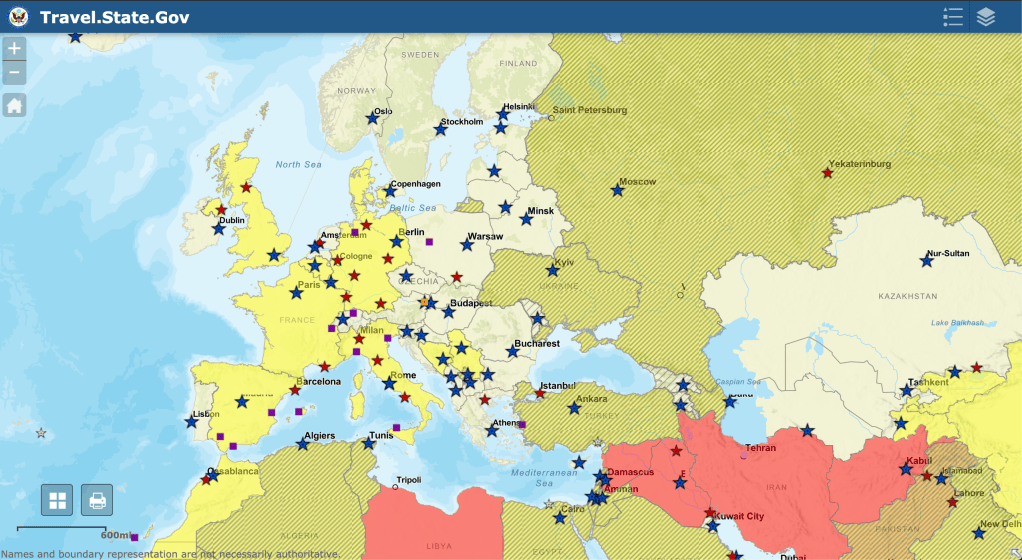
Not only this, but according to the Department of State’s travel advisory website, most countries in Western Europe encourage American travelers to exercise increased caution while in those countries, including the country in which I am currently residing. Below is a map published by the Department of State showing travel advisory levels in different countries.
This map shows countries with “exercise increased caution” advisories in yellow, “reconsider travel” in orange, “do not travel” in red, and “normal precautions” as is. US Department of State– Bureau of Consular Affairs.
On this map alone I’ve already been to four countries marked in yellow “exercise increased caution” advisories. Azerbaijan is also marked in yellow. I know it is a little troublesome to see how close the country is to the scary “do not travel” red zone, but the fact of the matter is that going to Azerbaijan is ultimately not being in Iranian territory. After looking at information on security measures for the tournament, I came across an article published by the government of the United Kingdom that described that, like I expected, there would be heightened security measures in place for the duration of the tournament in all host cities across the continent. It is encouraging to know that there is cooperation between host countries’ security officials in preparation for this event, and with people still expected to attend matches in Baku, there is no reason why I shouldn’t watch a match that I have tickets for.
The bottom line here is that there will always be a risk to do something new, such as going to a new country. However, preparing yourself for what you can expect in that new country or doing that new thing is the best thing that you can do to be able to prevent anything from going wrong. So, if I ultimately get over the financial hump of being able to afford flying to Baku, I will be careful and aware as I generally am while in a new place, but I will also remember to just have fun and enjoy my experience during my time there.
Sources used to help write this post:
https://travel.state.gov/content/travel/en/traveladvisories/traveladvisories.html/ – This is a good resource for those looking to travel to a foreign country to learn more about the country’s culture, important laws to know and abide by, transportation within the country, as well as things to be aware of in order to keep safe during your travels. Also gives contact information for US Embassies/Consulates in each country.
I am officially done with the 2019 portion of my Fulbright grant in Germany! It’s crazy to think that I’m not even halfway done with my time here, and going into 2020, there is one thing that I want to accomplish with the rest of my time here more than anything, and that is to take more weekend trips to see more of the country that I have studied so much during undergrad.
I think that with train travel and bus travel being as affordable as it can be with regard to traveling within Germany, I should be seeing more parts of the country than I have already. I’ll get to travel to some other cities with my Blackbirds teammates, but I also want to have some time to explore those cities in a deeper way, which will only come with taking a weekend trip. So, my goal for the rest of my time here is to take at least one weekend trip a month to different cities in Germany.
Although I’d like to increase the number of places I visit, I have just spent my last week of 2019 and first week of 2020 in two different countries, Hungary and Lithuania. My time in Hungary was like a homecoming for me in a way. My mom’s side of the family is Hungarian, as my mom grew up in Budapest, the capital city. I went to Hungary during Christmas to visit my grandfather and to celebrate the holiday with him.
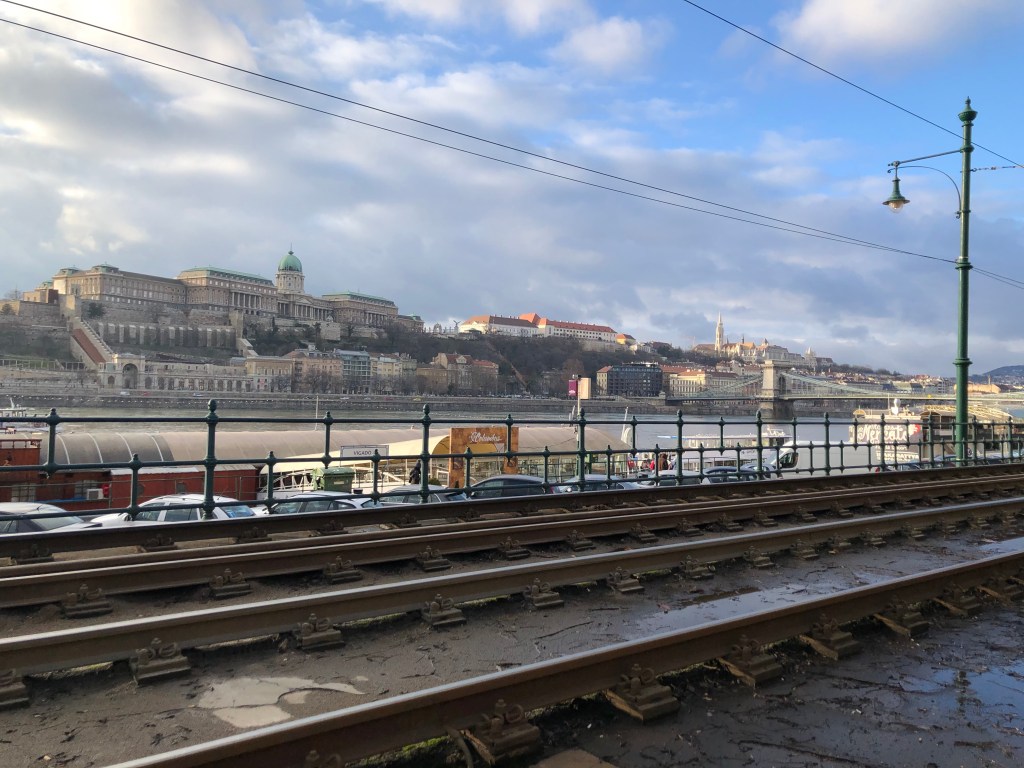
A view of the Buda Castle from across the Danube River.
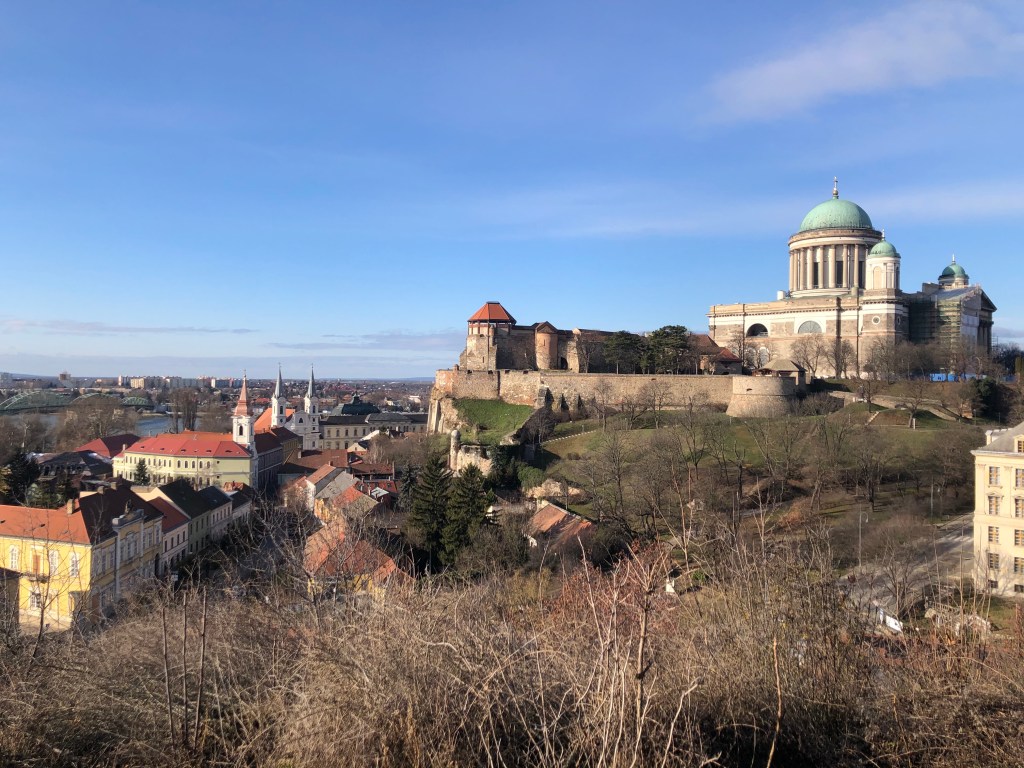
I was welcomed to his apartment with open arms and a classic Hungarian dish of csirkepörkölt, a paprika and chicken stew, with egg noodles. I had stayed with my grandfather in Hungary before for a comparatively longer time over the summer, but this was my first time in Hungary during the winter season, something that I really enjoyed. During my time in Hungary, I ate a lot of great Hungarian meals made by my grandfather, rented a car and drove with him to visit my grandmother’s godmother who is 97 years old (and counting!), and drove myself to the Hungarian city of Esztergom, the former capital of the Hungarian Kingdom back in Medieval times. And during my time in Budapest, my grandfather and I went to visit the Advent markets downtown near the banks of the Danube, and we visited the Hungarian National Museum, where I learned more about Hungary’s long and turbulent history.
The Esztergom Basilica (green-domed building) and the Royal Castle (center) overlooking Esztergom and Štúrovo, Slovakia (formerly Párkány, Hungary).
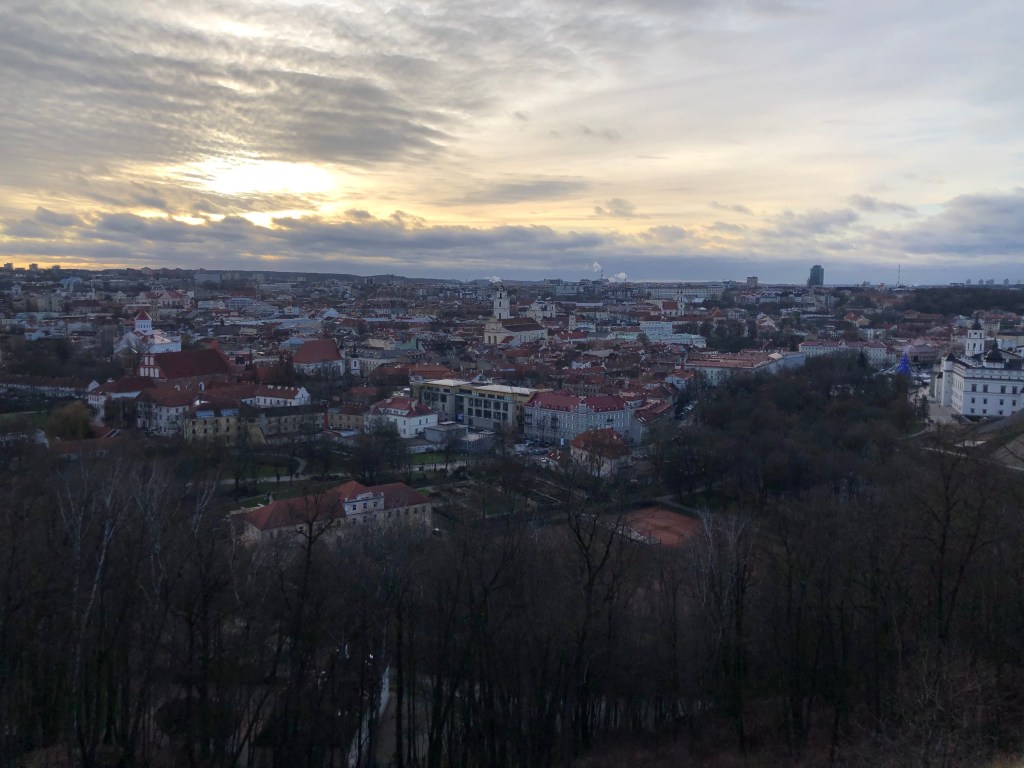
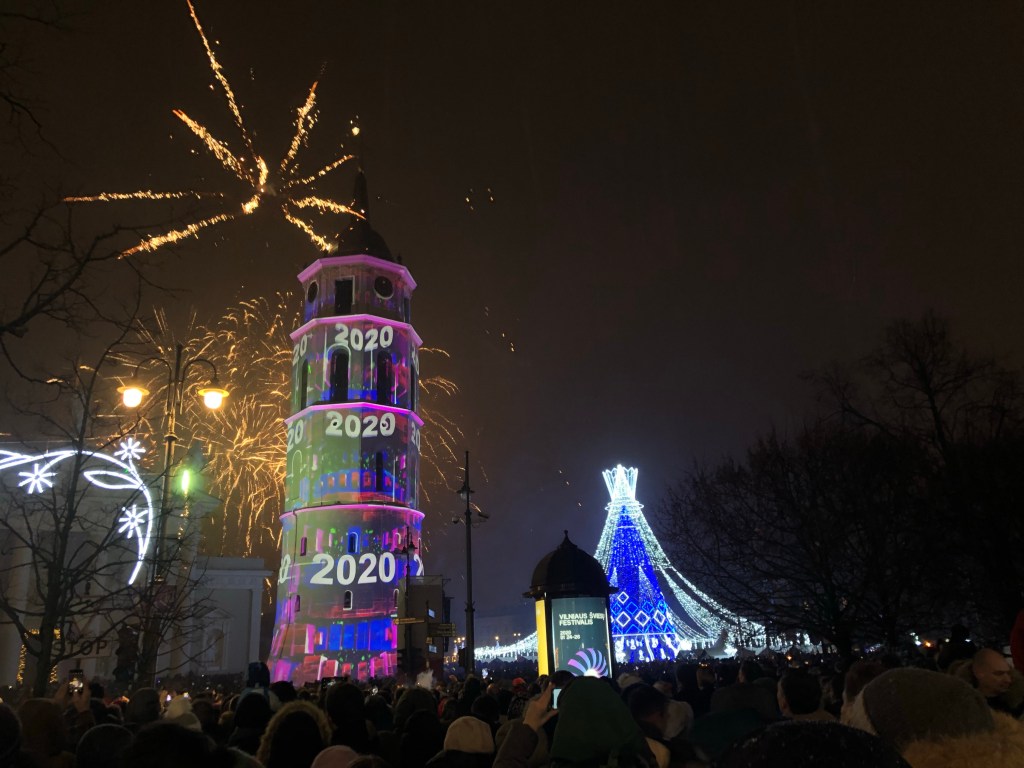
After taking an early morning flight out of Budapest on December 30th, I found myself in Vilnius, Lithuania for the turning of the new year. I never thought that I would spend my first day of 2020 in Lithuania, but with the help of Fulbright friends made in Germany, I was able to make a new friend with a Fulbrighter placed in Lithuania, Abby, who was kind enough to host me and my Fulbright Germany friend, Eddy, for the holiday. And seriously, what a host! Transportation in Lithuania and food was relatively cheap in the country, which allowed us to visit different cities between one and two hours outside of Vilnius.
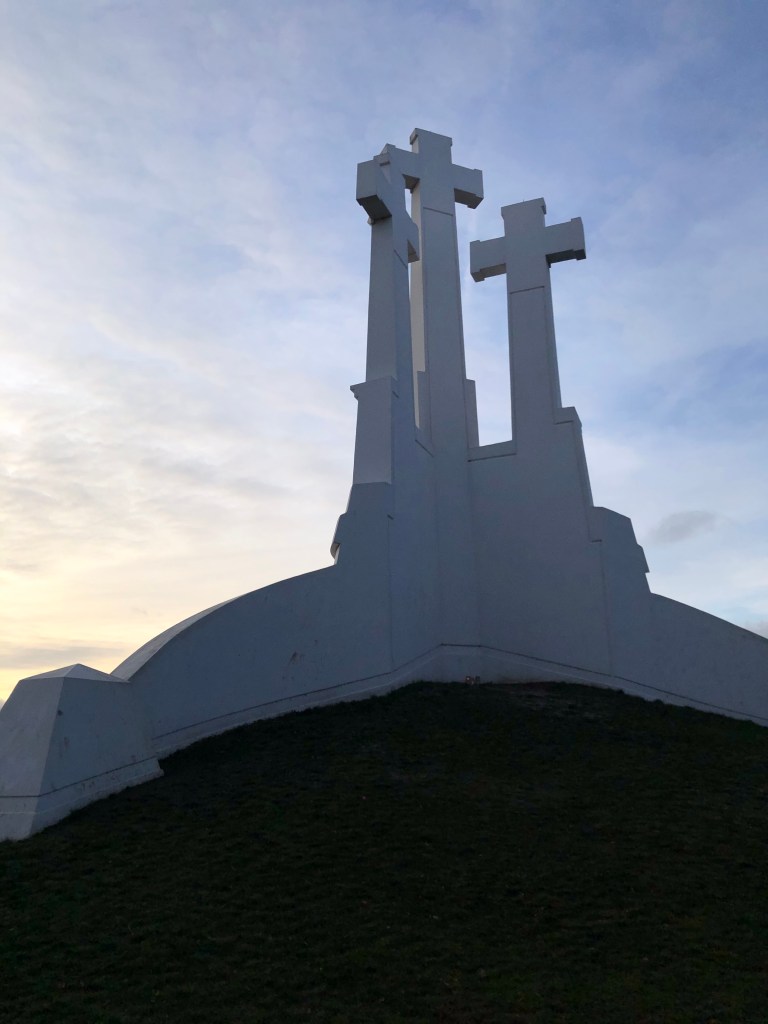
A view of Vilnius from the Hill of Three Crosses.
The three crosses atop the hill.
I didn’t know too much about Lithuania before going, but I learned a lot while I was there from Abby, as well as from the museums that we visited. Like Hungary, Lithuania also had a long history, first gaining significant territory under the rule of Duke Gediminas in the 14th century. The Duchy of Lithuania spanned from the Baltic Coast in the north as far down as the coasts of the Black Sea in the south. The shape and strength of Lithuania changed throughout the centuries, and with the rise of the Russian Empire, Lithuania was eventually taken into its territory in the 18th century. From that point on, Lithuania wasn’t able to become an independent state truly until the late 20th century with the collapse of the Soviet Union, and is currently a republic and both a member of the European Union and NATO.
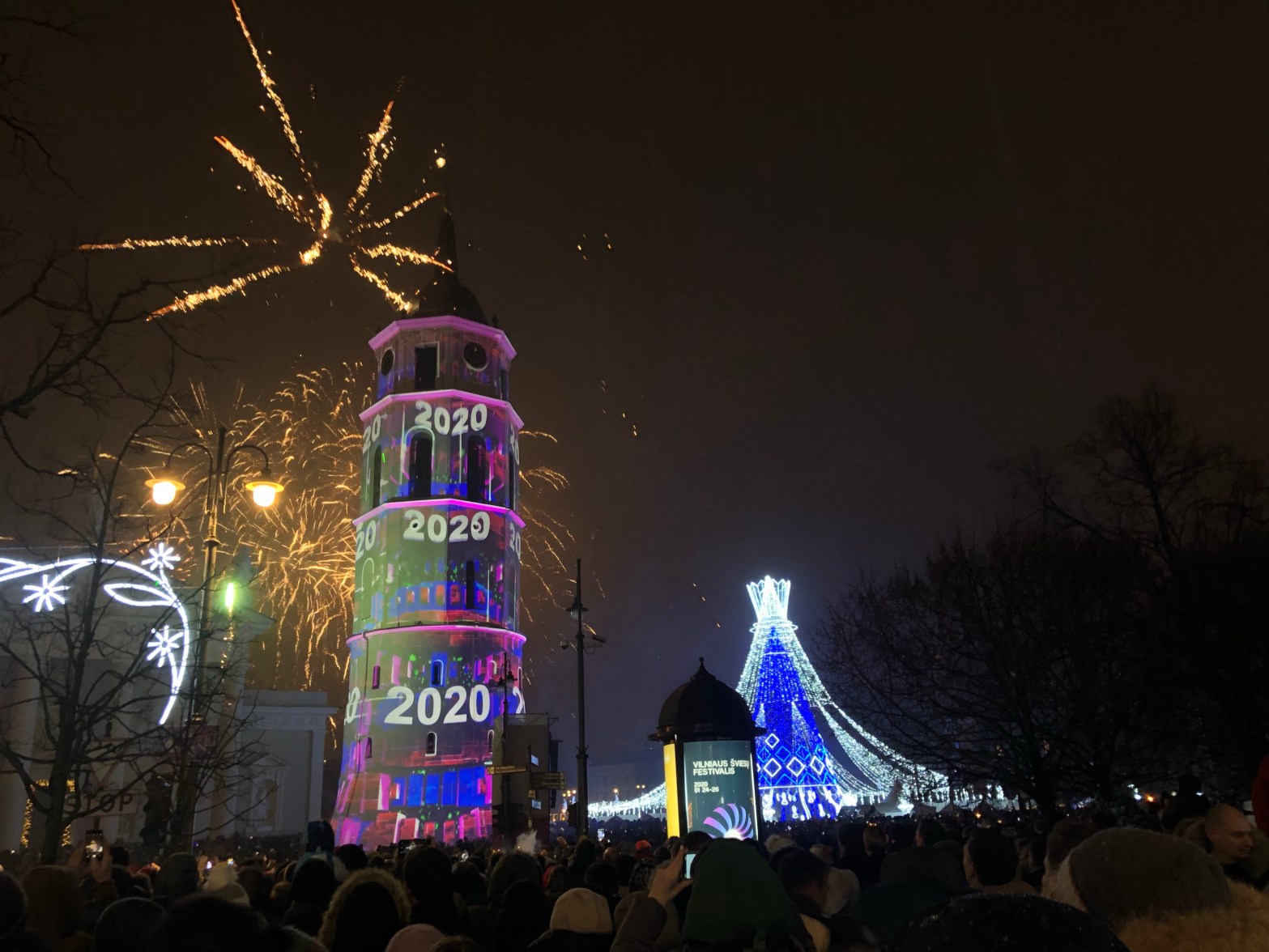
Fireworks after ringing in the new year at Cathedral Square in Vilnius. Fireworks were shot off all around the square by people who had bought some beforehand.
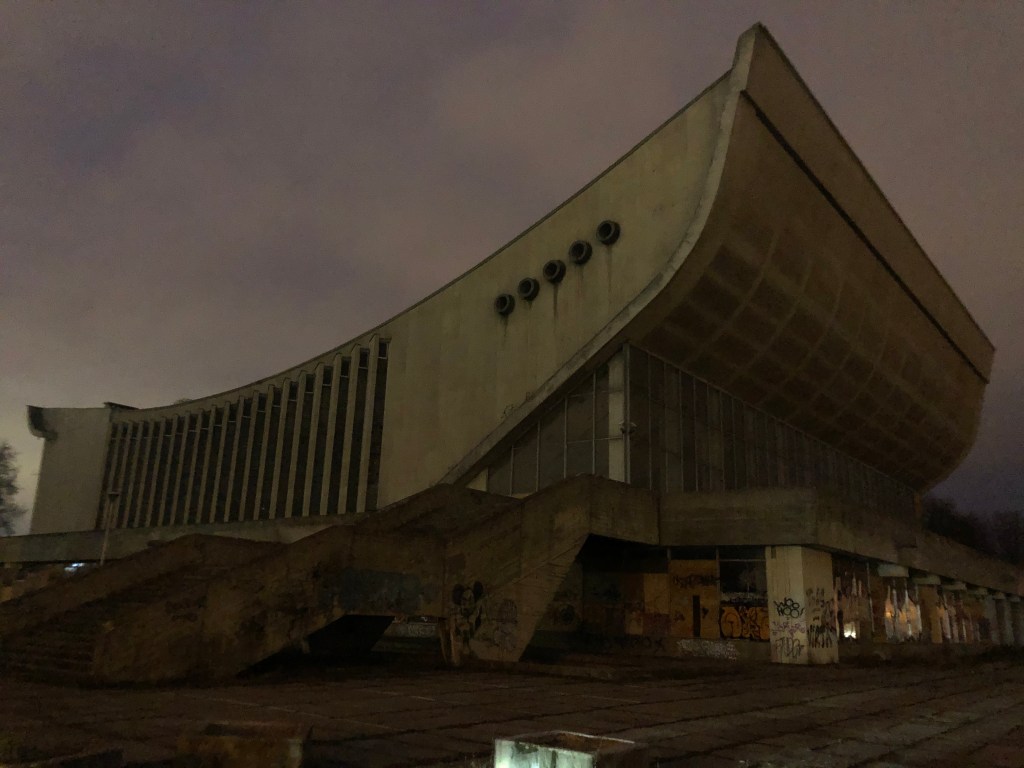
Looking around Vilnius today, one can find traces of its Soviet occupation and Russian influence throughout the city, from its Russian Orthodox churches to its antiquated Soviet trollies, as well as its extensive Soviet-style architecture. There are some abandoned buildings that were built by the Soviets scattered in the city, which leaves much to be imagined for those that can only imagine what it looks like inside.
The abandoned “Sport Palace” built by the Soviets during their occupation of Lithuania.
Vilnius is the furthest east in Europe that I have traveled, and it certainly did not disappoint. As a city in Europe, Vilnius is definitely underrated, and if you’re looking for a great vacation destination with a lot to do and is cheap, then definitely consider Vilnius as your next vacation destination. For now, though, it’s back to teaching here in Wolfsburg, eagerly awaiting my next trip to somewhere new.
A view of the city from the summit of the hill upon which the Imperial Castle sits.
On the weekend of my birthday, my girlfriend, Sandra, met me in Germany, and instead of staying in Wolfsburg, we decided to travel to a different German city. When we were deciding where we wanted to go, I gave her a list of a few different cities and towns in Germany, some of the highlights on that list being Hamburg in the north, Munich in the south, and Nuremberg between the two. All three places are large cities in Germany, but each with a different aura to them. Hamburg is a port city in the north, Munich the cultural center of Bavaria in the extreme south, and Nuremberg a historical, cultural center with a complicated past, with an intriguing medieval city center. The last of the three seemed the most interesting, so we booked train tickets and our accommodation, and we were ready for our trip.
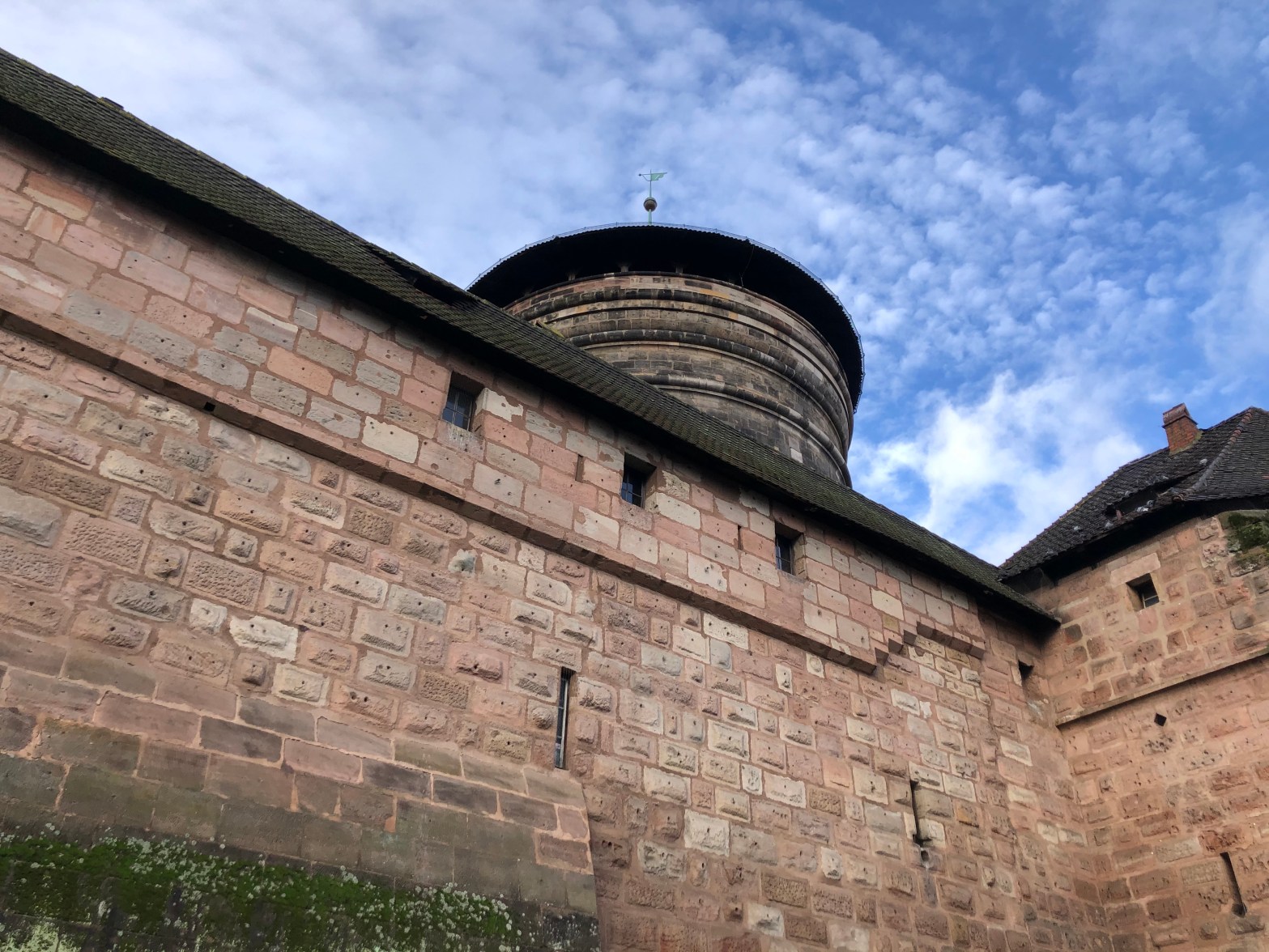
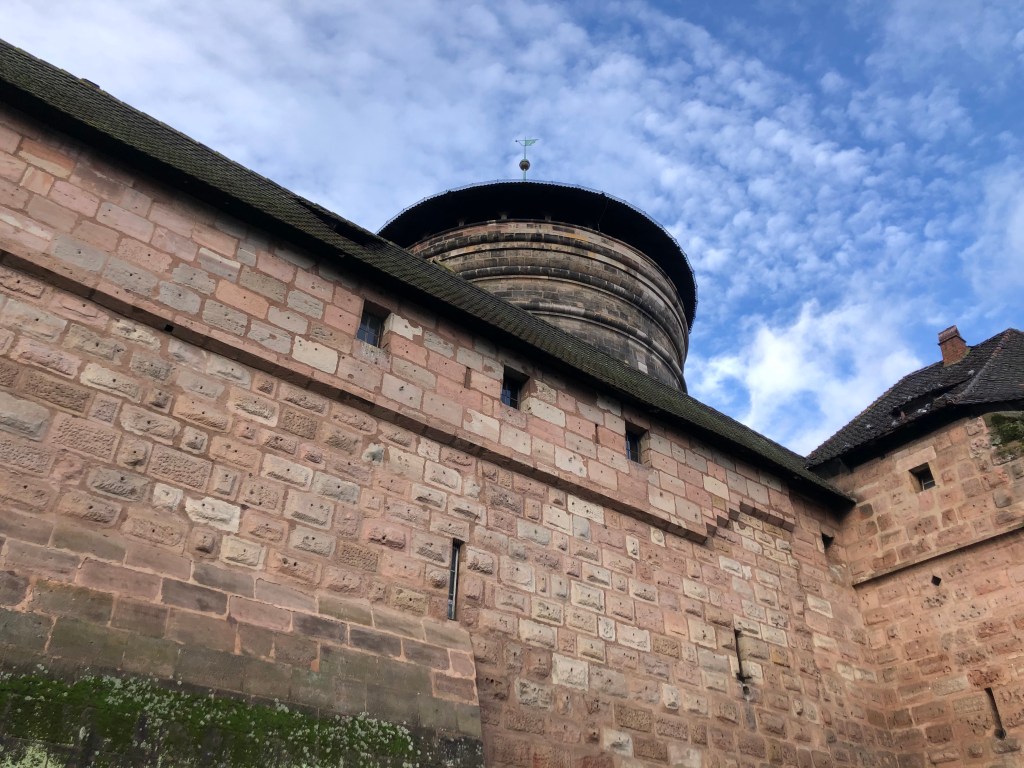
The first thing we saw when we walked out of the underground tunnel leading out of the train station to our surprise was a large, cylindrical tower, making up one corner of the old city. In World War II, several major German cities were severely bombed by Allied Forces, which left them severely damaged and a lot had to be rebuilt. Cities then had to make a choice; would they rebuild the medieval-style buildings, or would they modernize their cities and build anew? Nuremberg decided to rebuild the old, and it brings a unique charm to the city that other cities in Germany do not have. Sure there are some modern office buildings outside the city walls, and there are some newer buildings within as well. But the decision to rebuild the old was the right choice for Nuremberg, just because the way the city is organized called for that decision.
A tower located just inside the walls of the Altstadt (Old City).
To give a short history of the city, its origins date back to the early 11th century when the Imperial Castle was originally built. The city was one of the many seats of the Emperor of the Holy Roman Empire, which was meant to be a symbolic continuation of the Roman Empire of ancient times. This “empire,” however, was nothing more than a loose confederation of free German city-states, as Germany wasn’t united as a nation as it is defined today until 1871. Nuremberg was a powerful free city in the region of Franconia, and had its own autonomy until the early 19th century, when it was absorbed into the Kingdom of Bavaria. In the interwar period, Nuremberg gained a symbolic importance to the NSDAP (Nazi Party), as it was considered “the most German of German cities,” and later became the host city of Nazi Party rallies. After the war, the city ditched its industrial past, and turned toward tourism as its main industry, as it attracts millions of visitors every year, especially in the winter, for its world renowned Christkindlsmarkt, or Christ Child Christmas Market.
The city, teeming with history, was certainly worth the visit. The old town center filled with different Christmas market stalls selling various German festival foods such as the Nürnberger “3 im Weckla” (three sausages in a bun), Flammkuchen (a German-style pizza), and a glass of warm Glühwein (mulled wine). And the old buildings, some with mini altars to different Christian saints attached to them, and some with paintings depicting different biblical scenes, are things that distinguish the city from others in the country to which I have been. As a student of German in college, however, I think the biggest draw to the city for me was the Documentation Center, which is a historical archive of the activity of the Nazi Party in Nuremberg, and of the Party rallies that took place in the city during the interwar period.
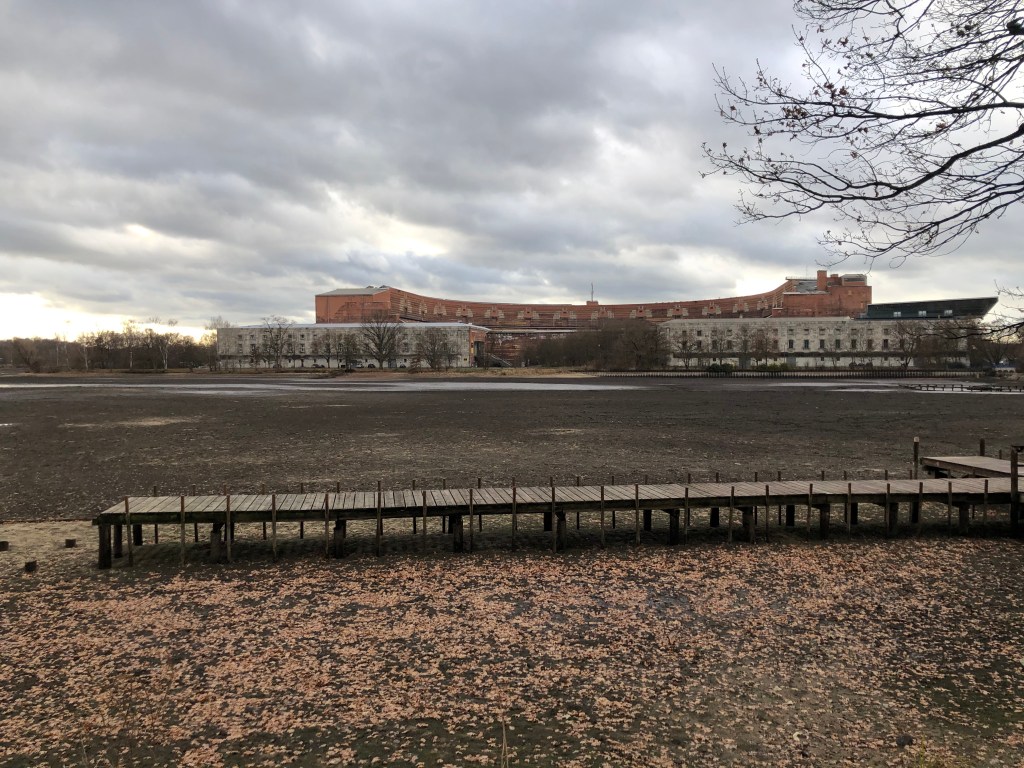
A view of the Congress Hall, a part of the Reichsparteitagsgelände (Nazi Party Rally Grounds) that was not completed and was supposed to be an exhibition hall to hold more than 50,000 people.
Having gone over this period of history several times during the completion of my degree in German Language and Literature, I thought I had learned a great amount about the Nazi Party’s rise to power, and how they were able to take control of every aspect of German daily life in the 1930s. It wasn’t until I came here saw the massive rally grounds, taking up far more space than the old city itself, that I got a true understanding of the scale of the efforts that Party leaders undertook to make their ideology the only ideology in the country. To have walked and stood in the buildings where high-ranking Nazi officials have walked and stood, to have seen the areas where hundreds of thousands of Party members had once stood, gathered orderly in regiment-style groups, worshipping a leader without questioning the legitimacy of his claims, gave me such a sick feeling that I even have chills thinking about it as I write this sentence.
In school I learned about the numbers behind the Holocaust, behind the growth of the Nazi Party in Germany, but this visit to the Documentation Center and to the buildings of the former Nazi Party Rally Grounds allowed me to put those numbers into context, which is something I find absolutely necessary to fully comprehend the atrocities that occurred during World War II and the Holocaust, and to empower people to speak out and take action against atrocities and violations of human rights that are occurring today.
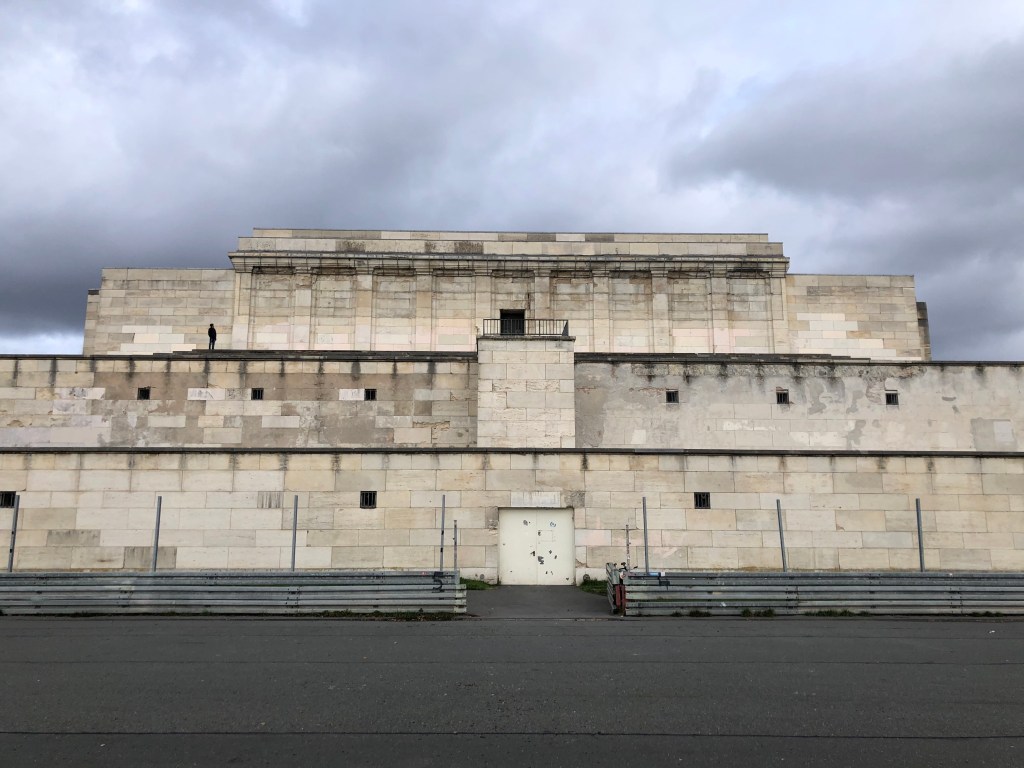
A part of the the Zeppelinfeld (Zeppelin Field), where high-ranking Nazi officials, including Adolf Hitler himself, gave speeches to thousands of his supporters in a “Cathedral of Light,” the aesthetic created by several spotlights shone into the sky representing a beacon for the Nazi Party.
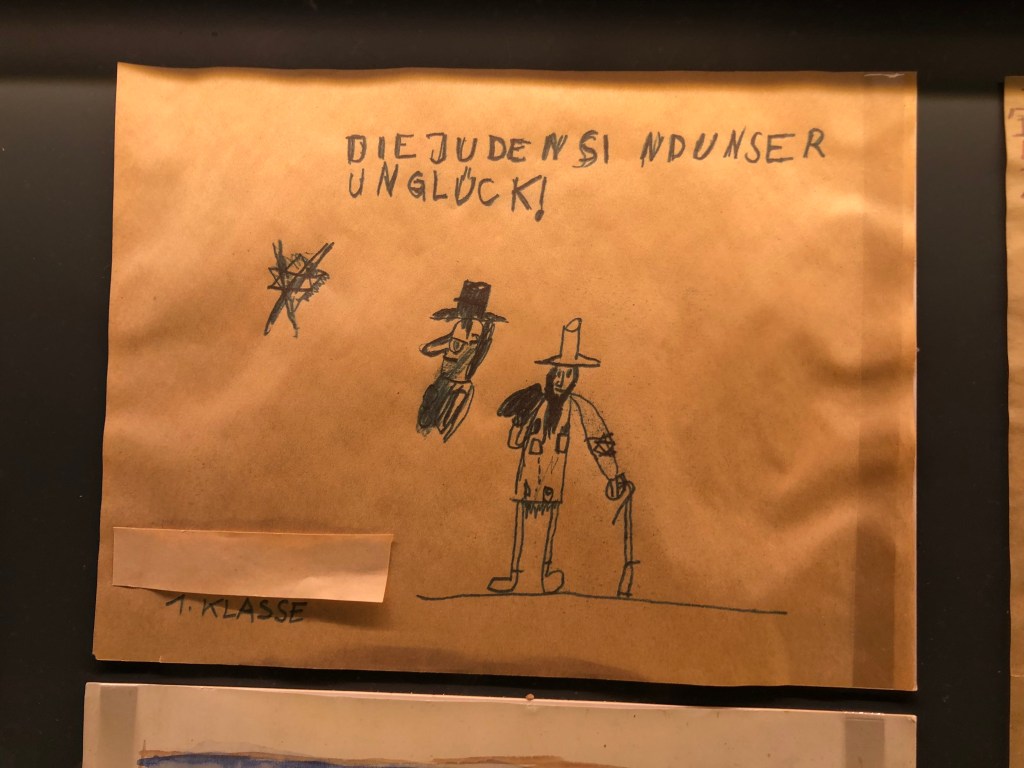
One example of the efforts the government under Hitler undertook to indoctrinate its citizens. This is a caricature of a Jew drawn by a first grader with the caption, “The Jews are our misfortune!” School children during this time were taught lessons on “the Jewish Question” in every grade, a form of propaganda that seeped down to the youngest of Germans.
When it came time to leave Monday afternoon, Sandra and I were quite sad to leave this city. It is a city with character and one with such historical importance to the world today. Almost fittingly, our favorite site in the city was the Straße der Menschenrechte (Way of Human Rights). On this street, there are 30 pillars, one to represent each of the 30 articles of the Universal Declaration of Human Rights, adopted by the United Nations three years after the end of World War II, with each article being expressed in both German and a different language, one different language for each pillar. What was once a city of symbolic important to one of the most evil and atrocious regimes the world has ever seen, the city seems to have become one to educate those on the events of the past to those who look for further information, and one that currently looks toward a brighter future, where human rights are respected worldwide. It is certainly one of my favorite cities I have been to in Germany so far.
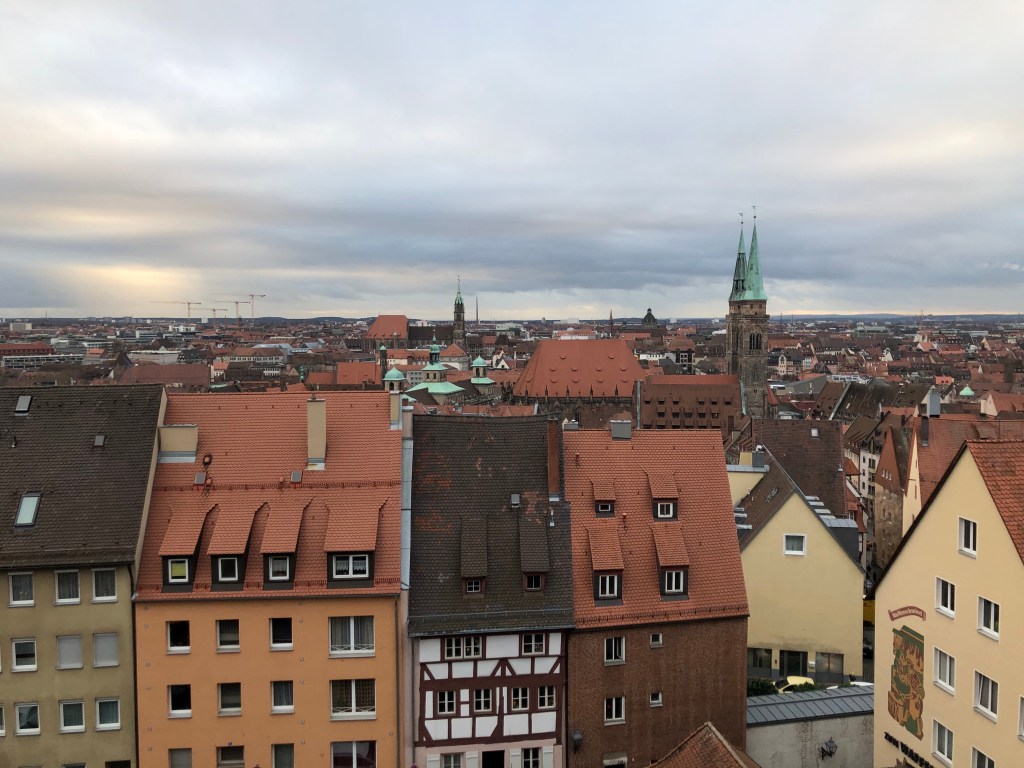
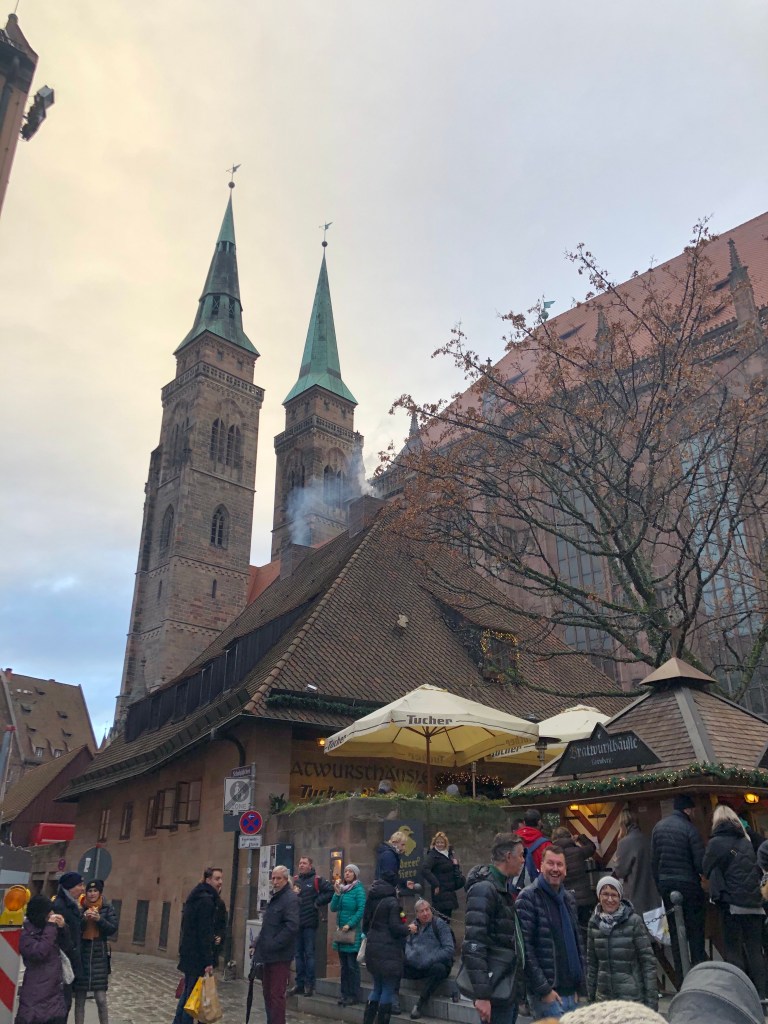
An image of St. Sebald’s Church, which is located just around the corner from the Christkindlsmarkt. One example of the beautiful medieval architecture that can be found within the city.
Something that’s great about Fulbright is that there is a community of people in your region that you’re able to reach out to to organize weekend plans and excursions, because let’s face it, there is a LOT of free time that just needs to be filled with doing something. There are about 14 of us teaching assistants from the United States in my Bundesland (state) of Lower Saxony, and one of my now great friends, Eddy, lives in a city only 20 minutes away from me by train.
During the orientation program, we were organized into smaller working groups to complete different exercises together, and they were divided up by Bundesland. That meant that I was able to meet all of the other teaching assistants around me. After having met the people who would be in the same region as me, it removed the awkwardness of simply reaching out to each other to organize weekend activities.
One problem that I face, and I’m sure other people face as well, is that even though Wolfsburg is a city, there isn’t really all that much to do, and ways to entertain yourself are exhausted quickly. I spend some of my free time training with the Wolfsburg Blackbirds, but in terms of doing other things with friends, my most convenient option is to go to Braunschweig (only 20 minutes away with the train) and hang out with friends there.
And not only are there English teaching assistants that are here working in Germany, but there are other language assistants from around the world teaching Spanish, French, Italian, and Chinese. In Wolfsburg, there is one other English teaching assistant from the UK, and a Spanish TA from Spain. But in Braunschweig, there are several teaching assistants from different parts of the world, and the PAD provides us with the contact information for the other TAs.
So, when it comes to having friends while in Germany, there’s really no need to worry. Before coming here, I worried about not being able to make friends with people here, and I worried about what I would be able to do on my free days. But with the size of the Fulbright program and the fact that the PAD encourages all of its teaching assistants to contact one another, I found that it was quite easy to get to know people here. Not only do I have my German baseball teammates to hang out with every now and then, but I also have my teaching assistant friends to spend time with or travel with if the opportunity arises. Getting to know so many different people and being able to share experiences with them is something I really appreciate about the Fulbright Program, and is, again, something which I believe they try to foster.
P.S. I’ll be going to Lithuania for the first time ever with Eddy to visit his friend (and my friend in a way now too) Abby. I’m really excited and am definitely planning on writing about my experience there.
P.P.S. I know I haven’t been writing as often, and I’m trying to get back on top of that. There are some other things that I want to write about, some travel, some Fulbright-related, and I hope to post about three more posts in the next two weeks!
“And looking ahead at the rest of my time here, I think this speaking club is exactly what Fulbright is trying to support: the exchange of ideas and cultures in a friendly setting for the ultimate betterment of people and the world.”
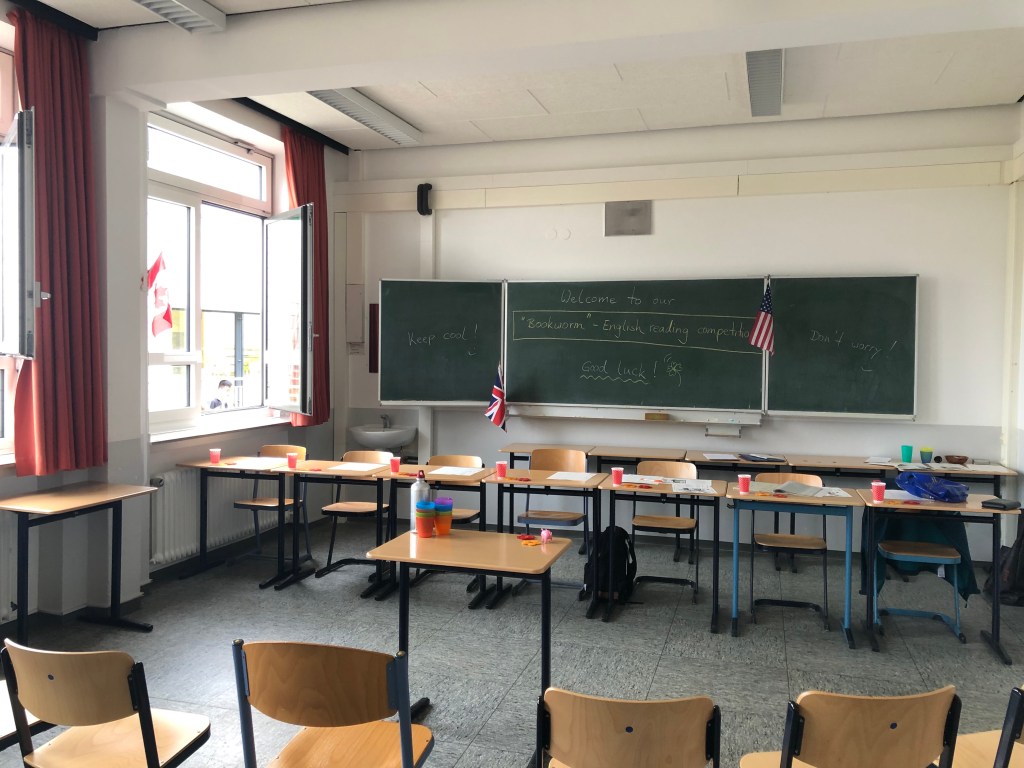
A classroom at THG set up for an English reading competition. Eighth Graders competed for a 10€ book store gift card in a reading competition, where each student was expected to read a prepared and unprepared text aloud.
As an English Teaching Assistant, I’m supposed to accompany teachers in their classes for about 12 lessons each week, with each lesson lasting about 45 minutes. An ETA’s schedule can vary depending on which school one is placed in; for example, my schedule has 5 fixed lessons each week with two Cambridge English Exam prep courses, which are actually extracurricular activities, and the other fixed lesson being an English speaking club–something a little more relaxed than my German recitations I was required to attend at Tufts.
The remainder of the time I have to spend at school each week is determined when teachers invite me to come and assist them in their classes. Some of the other people I know from Fulbright don’t have the same experience with their schedules. According to the guidelines set by the PAD (the German Educational Exchange Service), schools are technically supposed to provide all Foreign Language Assistants (FSAs–from Fremdsprachenassistenten in German) with a schedule to help in specific classes each week. Some schools however, like mine, want to make the most out of having a FSA, which is something that isn’t guaranteed every year, and so they want to make sure most of the kids get a chance to work with them.
I’d say that having an open schedule comes with its advantages and disadvantages. One really great thing is that because of the days when I have a fixed schedule (Wednesday and Friday), I’m able to have at least Mondays and potentially even Tuesdays off if I want. This would allow me time to travel to different places spontaneously should the opportunity arise.
However, a couple of disadvantages with this scheduling system has been that it takes a little bit for teachers to reach out to me and invite me to their classes. As an example, tomorrow is Friday and I don’t know whether I’ll be able to fill my hour requirements for next week since teachers haven’t reached out to invite me to help them yet. Another disadvantage to this schedule in terms of my performance as an ETA is that visiting so many different classes means I’m meeting hundreds of students, and it’s taking me a while to learn names. This makes it feel like I’m not able to connect with the students on a more personal level, which is something I believe the Fulbright Program means to foster and encourage in host schools.
But on a more positive note, my experience so far with my fixed lessons each week have been fun and meaningful. As I said, I lead an English speaking club offered to the 11th graders due to the fact that a lot of these students are coming back from being abroad in an English-speaking country. It’s been hard to find a balance of discussing topics that will challenge the students and keeping a fun, relaxing environment where they can speak freely. In the first meeting that we had I showed them a clip of the TV show Ghost Hunters because it was close to Halloween, and they absolutely loved it. They were shocked to learn that approximately 45% of Americans believe in supernatural spirits of some kind, compared to the 17% of Germans. They certainly found the show entertaining, not really because they believed that evidence of ghosts was being captured on the hunters’ devices, but because they believed the whole thing was quite funny.
Moving from that week to the next, I decided to bring a transcript of a NPR report regarding the “perennial problem of cultural appropriation through Halloween costumes” in the United States. As someone who has been to Germany before and has studied a lot about German culture, I know that there is a lack of sensitivity toward other cultures in the country, and I was interested to see how the students would react. The report talked about how stores in the US sell costumes that depict caricatures of certain cultures, like that of Native Americans or even Mexicans. After giving them time to read the report, I asked them what they thought about it and if it was something that was a problem in Germany. I wasn’t very surprised when most of the students said that they didn’t find an issue with wearing such costumes: that if people seriously scrutinized every costume that people wore during Halloween or Karnival or other costume parties, then such parties wouldn’t be fun anymore.
I went back to a line in the report which stated that the caricature of Native Americans depicted through these costumes comes from a time where several thousands of Native Americans were either slaughtered, raped, killed by European diseases or forcibly removed from their land. I then asked the question again: knowing this history and about the plight of these people, is it appropriate to wear that as a costume to party? Now, I’m not sure if I was totally able to change their minds on the matter, but they clearly seemed to think more about the implications. One student was even able to admit, “It’s hard to say.”
What I want to be able to do with this speaking club is not paint an entirely wonderful picture of the United States. I think it would be dishonest to do so. Our country is seriously flawed in its own ways. While I want to show them that the US is a great country in my mind, I also want to introduce them to the issues that people there currently discuss, which will hopefully allow them to consider the issues in their own country of Germany as well. The treatment of people with migration backgrounds (not the friendliest of terms, either) is a serious issue in Germany today. And looking ahead at the rest of my time here, I think this speaking club is exactly what Fulbright is trying to support: the exchange of ideas and cultures in a friendly setting for the ultimate betterment of people and the world.
So while my schedule is all over the place for now, I’m happy for those fixed times during the week where I know that I am making a more personal impact with my students.
If you guessed that they are all things you think of when you hear the word Naples, then you’re right! At least for me, I suppose. One great thing about the Fulbright Program, and especially in Germany, is that there are some long vacations throughout the year planned that allow you to travel a decent amount. We recently had our fall break here in Lower Saxony, giving students and teachers a little more than two weeks off from school.
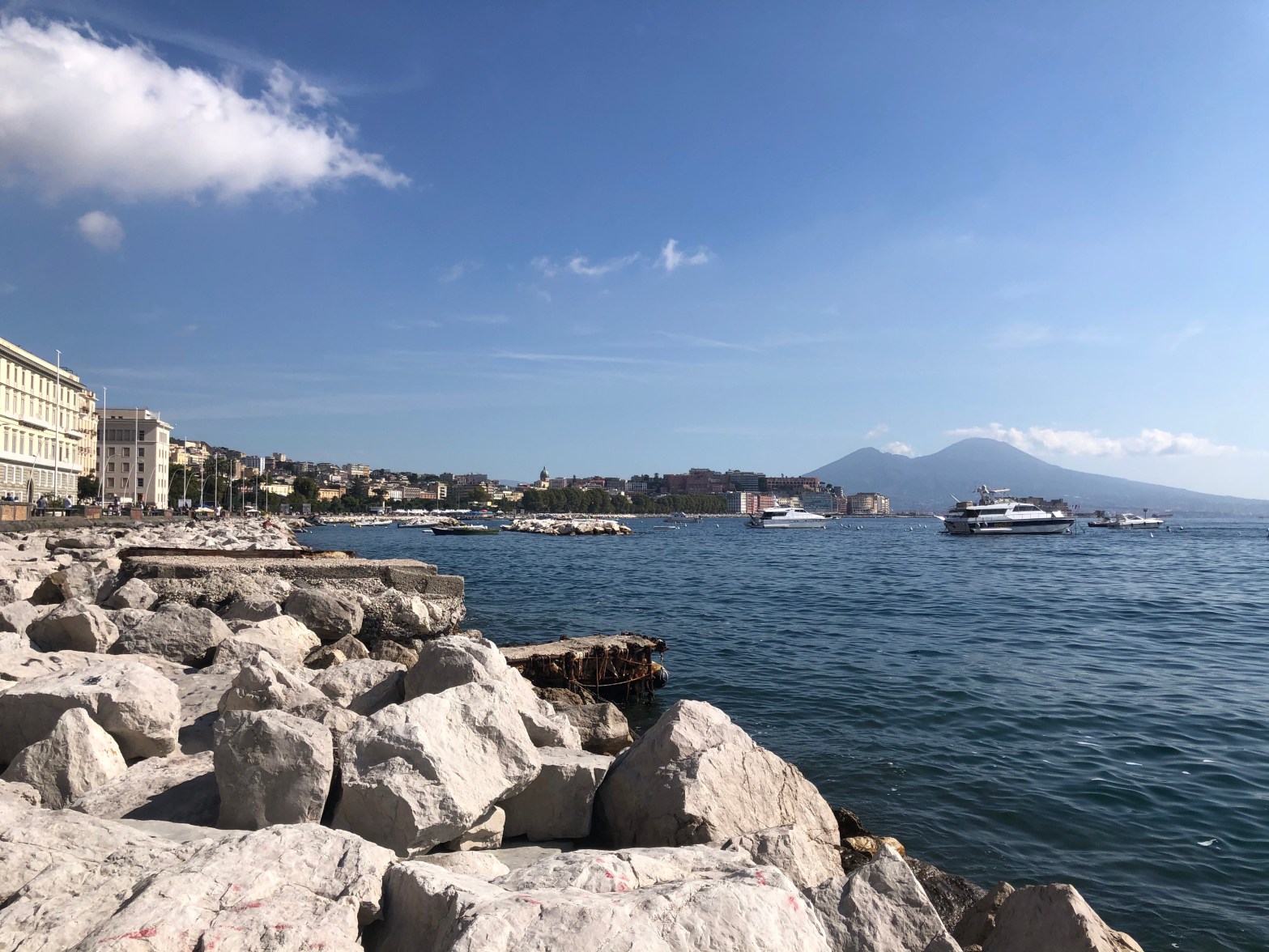
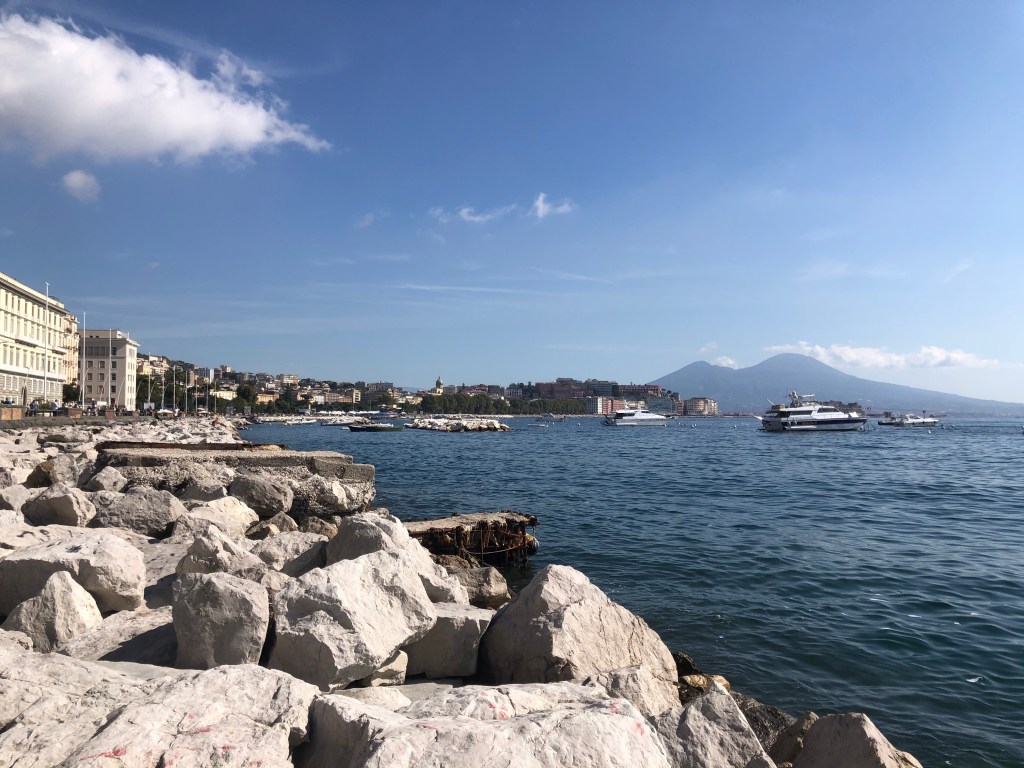
A view of Mount Vesuvius from the marina in Naples.
With these two weeks I had already planned a trip to Spain and Italy, the focus of this blog post being on Naples. I had already been to Madrid in September before this program had officially started, and it’s a great city, but Naples is something different.
One of the things that you notice immediately upon leaving the airport is that driving in Naples isn’t like driving around most of Europe. Lines on the road are mere suggestions, right-of-way upon entering rotaries is disregarded, and the sound of horns honking can be heard quite frequently. I went to Naples with a friend of mine, and when we were picked up by our AirBnb host, he asked if either of us had been to India, which I have, and he compared traffic in the city to that of big cities there. It was clear that this was the case. As cars tried to find their way through the heavy traffic near Piazza Garibaldi, some people on motorbikes swerved through the madness and continued on their way.
The AirBnb was located near the Piazza, and from what we had heard, it wasn’t supposed to be the safest of areas. The buildings seemed a little run-down on the outside and trash was scattered in the streets. However, we came to find that the area wasn’t as notorious as it seemed, especially if you are aware of your surroundings and know where you need to go; one can definitely stay safe in this city with general common sense. The location made the AirBnb a little cheaper, which was a plus, and even though it was very close to a very busy train station, it was removed enough to feel as though you were staying in an area with more locals than tourists.
As we began exploring the city, one thing became clear to us: Naples didn’t have the feeling of many European cities. This city is one with an incredibly long history and has been under the rule of many different kingdoms and empires. There are several small streets and alleyways for people to explore, and the buildings still look pretty run down on the outside. Shopkeepers shout from their stores to try to attract business, pizza-makers shout up to regular customers across the street to let them know that their order is ready, and motorbikes make their way through the streets crowded with tourists constantly honking at them in order to get their attention to tell them to move. Buildings were also riddled with graffiti, and even though it’s seen sometimes as damage to someone’s property, the fact that most buildings had some type of graffiti on it added to the city’s personality.
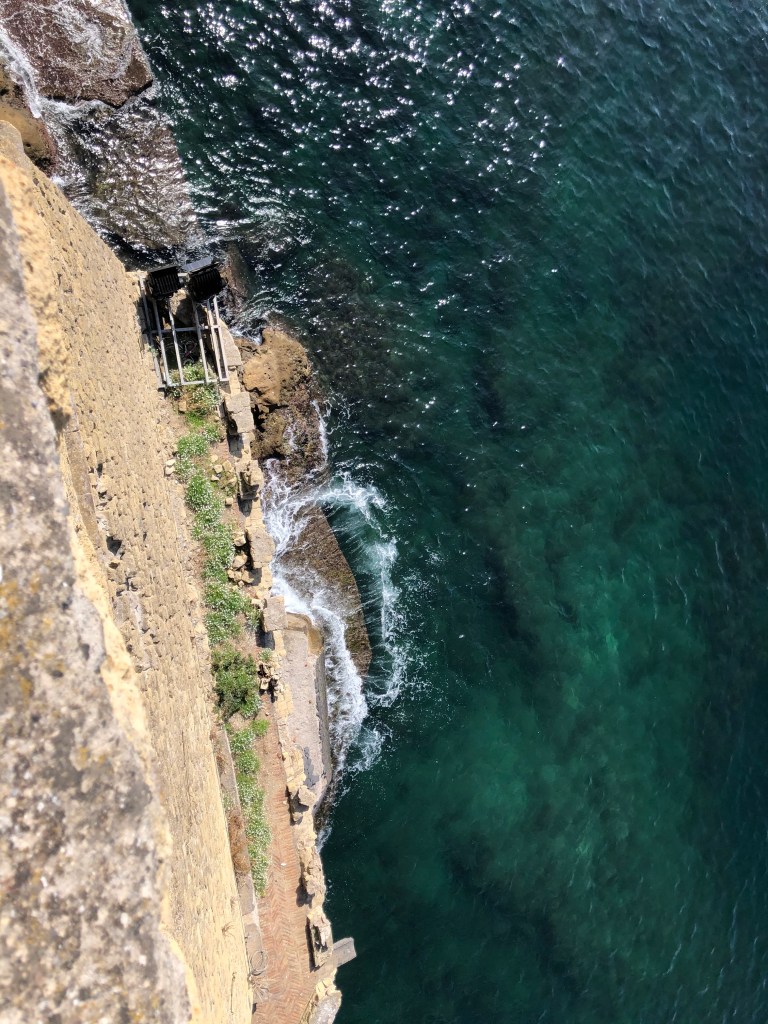
Looking down from the heights of the Castel dell’Ovo at the clear blue-green water.
Our AirBnb host was right. Traffic was certainly like that of Indian cities, but the feeling of the city didn’t feel European either. I thought it could have just been a Southern Italian thing, and I haven’t explored that much of Southern Italy to really know, but when I checked out Sorrento, a town on the Amalfi Coast, in the same trip, the streets were much cleaner, and the environment was less hectic. The best way that I could describe the feeling of Naples is if I were randomly dropped there, and not knowing I was in Naples I were asked where I was, I would probably say some city in the Middle East. It had such a unique feel to it that I couldn’t describe it in any other way.
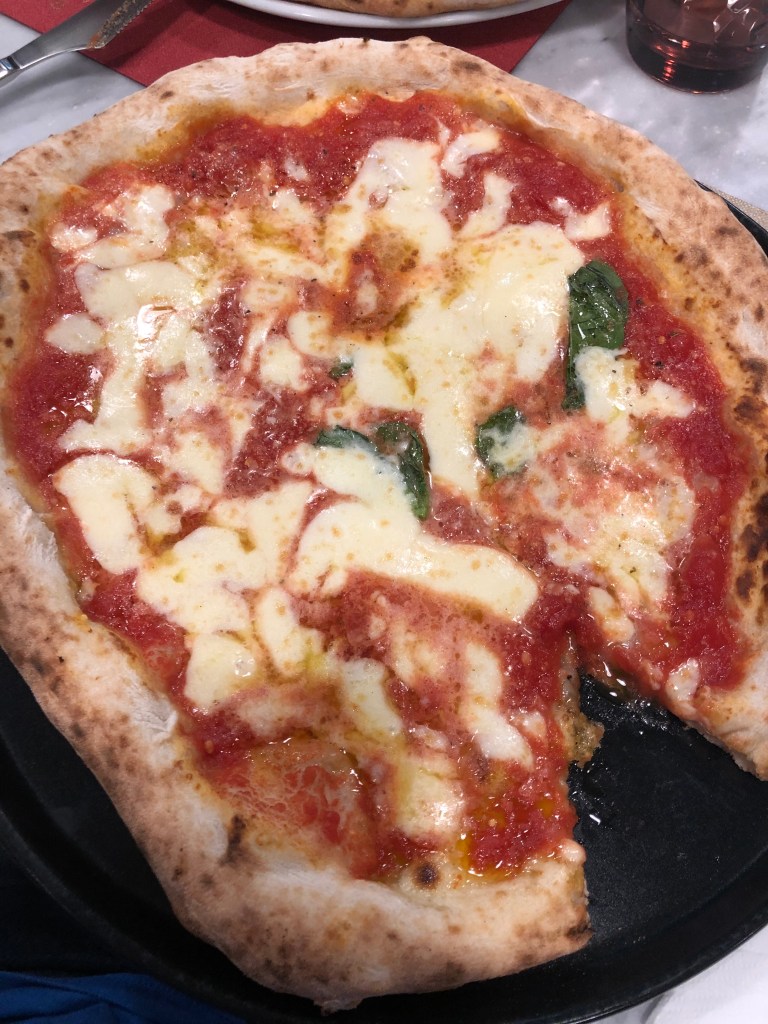
The one thing that was definitely Italian was the food. There were plenty of options around the city for cheap pizza; the classic Margherita at most places only cost 5€, and the quality was amazing. We were only able to try three different places, each priced around the same, and our favorite wasn’t one recommended to us by our AirBnb host, but rather one we found right around the corner from us called Pizzeria Carmnella. If you’re ever staying near Piazza Garibaldi, it is a must to go there (just don’t try to go on Sunday, they’re closed then!).
This is an example of the quality of the pizza at Carmnella’s. I was so hungry that I took a bite before I could get a quality picture!
We also found some other great places for pasta and didn’t really follow the ones recommended to us by our host, and I think it’s fair to say that as long as you don’t go to a trattoria that looks super touristy or that looks like it serves quickly-made food, you’ll probably have a great experience while you’re there.
In the end, we had a really great time in Naples. The only day we had planned was our excursion day to Pompeii and Sorrento on Saturday, and the other days were spent walking around different areas of the city just exploring the streets. Each part of the city had something new, and it was all very exciting. I think that’s a great thing about traveling to somewhere new. It’s nice to have some plans, but then also leave things wide open to wander around and explore. You might stumble across something you might not have otherwise come across.
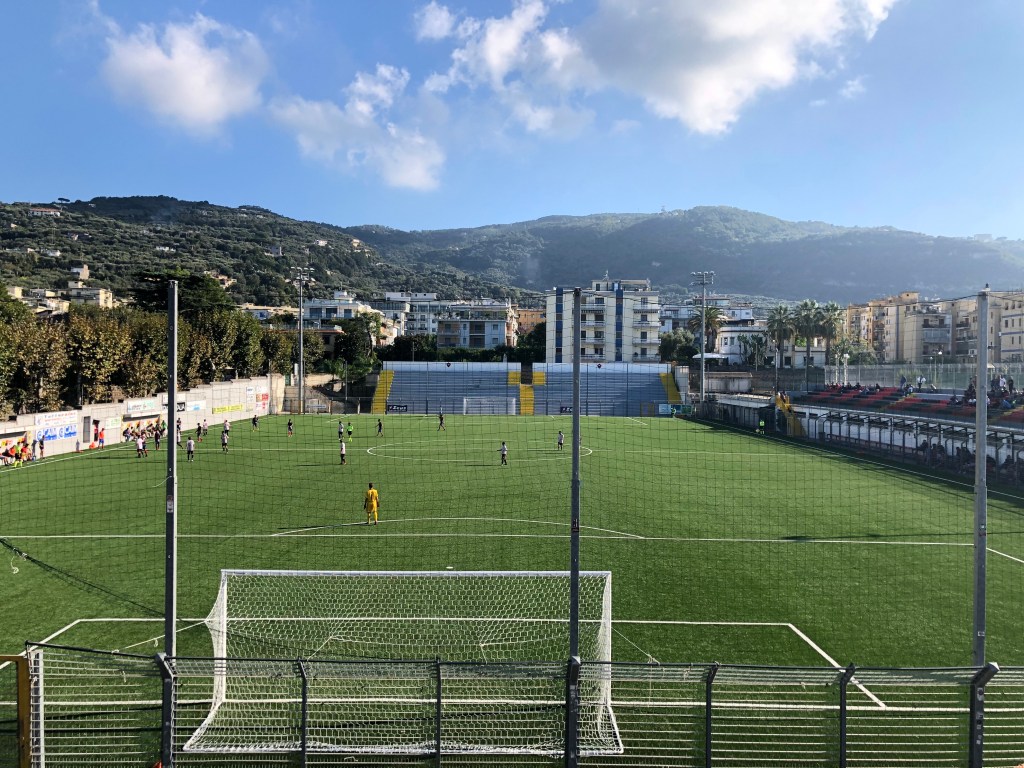
A pretty cool soccer stadium we came across at the foothills of the mountains of the Amalfi Coast in Sorrento.